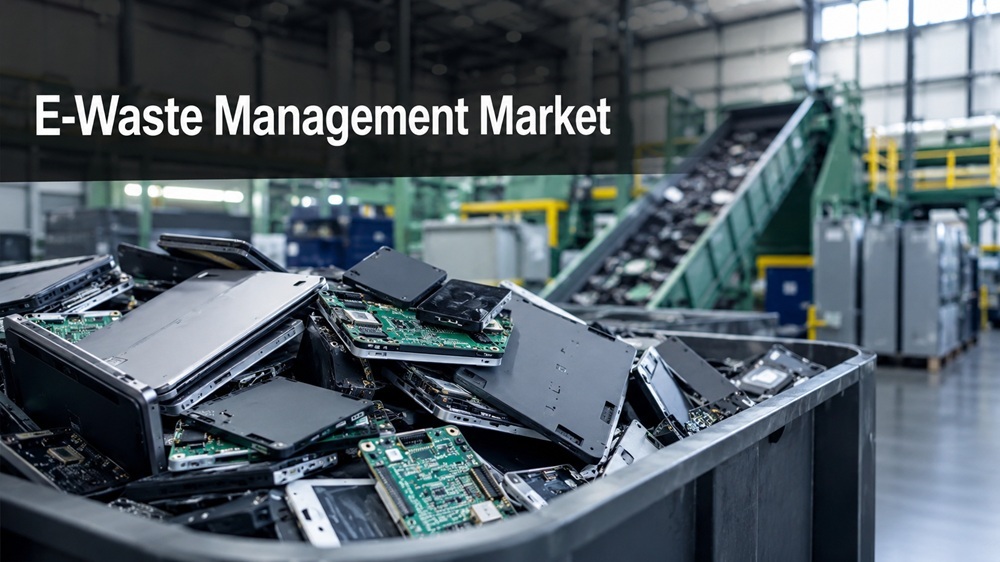
The E-Waste Management Market is expanding steadily as governments, manufacturers, and consumers prioritize responsible disposal of electronic products. Rising volumes of discarded electrical and electronic equipment, stricter environmental regulations, and improvements in recycling technologies are encouraging investments across the value chain. According to BIS Research, the market is expected to witness strong long-term growth, supported by increasing resource recovery initiatives and sustainability-focused policies.
According to BISResearch, the E-waste management market is projected to reach $71,588.3 million by 2034 from $17,125.7 million in 2023, growing at a CAGR of 14.22% during the forecast period 2024-2033.
What are the Key Drivers of the E-Waste Management Market?
Growing consumption of electronic devices is increasing the volume of end-of-life equipment requiring proper collection and recycling.
Government regulations and Extended Producer Responsibility (EPR) programs are strengthening formal recycling systems.
Rising awareness of environmental protection is encouraging businesses and consumers to adopt sustainable disposal practices.
The recovery of valuable materials such as gold, copper, silver, and rare earth elements is improving the economic viability of recycling operations.
What are the Emerging Trends in the Market?
Automation and AI-enabled sorting technologies are improving recycling efficiency and material recovery.
Circular economy strategies are encouraging product reuse, refurbishment, and resource optimization.
Digital tracking and compliance systems are enhancing transparency across e-waste collection networks.
Partnerships between manufacturers, recyclers, and governments are expanding formal recycling infrastructure in developing and developed economies.
Get An Updated Sample for E-Waste Management Market – Focus on Application, Product, and Region – Analysis and Forecast, 2024-2034
What are the Major Applications of E-Waste Management?
Recycling remains the primary application within the market, as it enables the safe processing of discarded electronic products while recovering valuable raw materials for reuse. Consumer electronics generate a significant share of e-waste because of rapid product replacement cycles. Efficient recycling minimizes landfill waste, reduces environmental risks, and supports sustainable manufacturing by lowering dependence on newly extracted resources.
How Does Regional Performance Influence Market Growth?
Asia-Pacific represents a major growth region due to increasing electronics production, expanding consumer demand, and supportive government initiatives for waste management. North America and Europe continue to strengthen their positions through mature recycling infrastructure, regulatory compliance, and circular economy programs. Emerging economies are also investing in formal collection and recycling systems to improve environmental performance and resource recovery.
What Challenges and Opportunities Shape the Market?
The market faces challenges including inadequate recycling infrastructure in several regions, the dominance of informal recycling practices, and the complexity of processing modern electronic devices. Limited consumer awareness and inconsistent collection systems also affect recycling efficiency.
Despite these challenges, significant opportunities exist through technological innovation, expansion of formal recycling facilities, stronger regulatory enforcement, and growing investments in circular economy initiatives. Increasing demand for recovered critical materials is expected to further strengthen the long-term outlook for the E-Waste Management Market.
Get More Insights for Advanced Materials, Chemicals & Fuels Market
Conclusion
The E-Waste Management Market is becoming an essential component of global sustainability efforts. As electronic waste generation continues to rise, advancements in recycling technologies, supportive environmental regulations, and increasing adoption of circular economy principles will continue to drive market expansion. Organizations that invest in efficient collection, material recovery, and responsible waste management practices are well positioned to benefit from the industry’s long-term growth potential.