No Result
View All Result
  • Login
Tuesday, June 23, 2026
theadvisertimes.com
  • Home
  • Business
  • Financial Planning
  • Personal Finance
  • Investing
  • Money
  • Economy
  • Markets
  • Stocks
  • Trading
  • Home
  • Business
  • Financial Planning
  • Personal Finance
  • Investing
  • Money
  • Economy
  • Markets
  • Stocks
  • Trading
No Result
View All Result
theadvisertimes.com
No Result
View All Result
Home Money

Can you hedge against a market crash with ETFs?

by theadvisertimes.com
6 months ago
in Money
Reading Time: 4 mins read
A A
0
Can you hedge against a market crash with ETFs?
Share on FacebookShare on TwitterShare on LInkedIn


That approach, however, comes with trade-offs. Higher fees are a real issue, as many alternative strategies rely on active management. Complexity is another. Finding ETFs that genuinely diversify returns rather than just repackage familiar risks is not easy. And even when you get the construction right, one major gap remains. The portfolio is not designed to protect against a true market crash. When I say crash, I mean sudden, deep, double-digit drawdowns like those seen during the 2008 financial crisis or the sudden collapse in March 2020 at the onset of the COVID-19 pandemic. 

Source: Testfolio.io

In the sections that follow, I will walk through two ETF approaches that retail investors have access to, highlighting Canadian-listed options where available. It is worth noting up front that the Canadian market is far more limited than the U.S. in this area, but you still have a few options.

And while these strategies can offer protection in specific scenarios, there is no free lunch. As you will see, the costs, complexity, and implementation challenges often make crash-hedging ETFs difficult to use effectively, even for experienced investors.

Option 1: Inverse ETFs

Inverse ETFs are designed to be short-term trading tools that aim to deliver the opposite return of a benchmark over a single trading day. Most track broad market indexes, though some focus on specific sectors or even individual stocks. The key point is that their objective resets daily. They are not built to provide long-term protection.

A well-known U.S. example is the ProShares Short S&P 500 ETF (NYSEArca:SH). On any given trading day, SH targets a return equal to negative one times the daily price return of the S&P 500. If the index rises 1%, SH should fall about 1%. If the index drops 1%, SH should rise about 1%. In practice, it does a reasonable job of delivering that daily inverse exposure.

For investors seeking stronger downside protection, leveraged inverse ETFs are also available. These apply leverage to magnify the inverse relationship. An example is Direxion Daily S&P 500 Bear 3X Shares (NYSEArca:SPXS), which targets negative three times the daily return of the S&P 500. If the index falls 1% in a day, SPXS aims to rise roughly 3%. If the index rises 1%, SPXS should fall about 3%.

Canadian investors have access to similar products now. Instead of using U.S.-listed ETFs, investors can look at options such as the BetaPro -3x S&P 500 Daily Leveraged Bear Alternative ETF (TSX:SSPX). 

Article Continues Below Advertisement

Outstream Pause Icon

Outstream Volume Icon

Skip Ad

X

During sharp selloffs, these ETFs can do exactly what they are designed to do. During the March 2020 COVID-related market panic, as the S&P 500 plunged, inverse ETFs like SH and leveraged versions such as SPXS rose sharply, with the leveraged funds moving by a much larger magnitude.

Source: Testfolio.io

As the chart above shows, the problem with these ETFs turns up once the panic passes. As markets recovered after March 2020, both unleveraged and leveraged inverse ETFs began to fall steadily. This highlights the core limitation of these products: you cannot buy and hold inverse ETFs if you accept that, over time, equity markets tend to rise. A permanent short position against the broad U.S. stock market is structurally a losing bet, which is why issuers are careful to emphasize that these products are intended for day trading only.

That creates another challenge. Using inverse ETFs effectively requires anticipating the crash and positioning just before it happens, then exiting before the recovery begins. That is market timing, and it’s not only an active strategy; it requires being right twice. Even professional investors struggle with this consistently, and retail investors tend to fare worse.

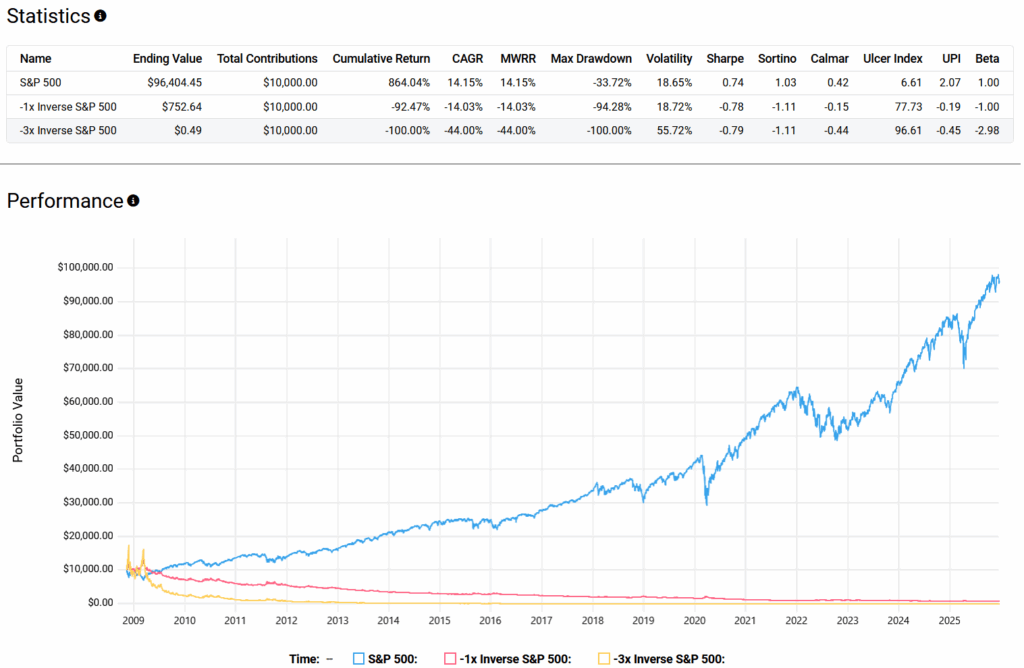
The long-term outcomes reflect those headwinds. Over a roughly 17.1-year period from November 5, 2008, to December 18, 2025, a buy-and-hold investment in inverse ETFs like SH and SPXS would have effectively gone to zero after many reverse splits.
Source: Testfolio.io

That outcome is driven by several factors. First, the underlying benchmark generally trends upward over long periods. Second, inverse ETFs carry relatively high fees, with expense ratios of 0.89% for SH and 1.02% for SPXS. Third, daily compounding works against investors in volatile markets. When prices swing up and down, the daily reset causes losses to compound faster than gains, creating volatility drag.

In short, inverse ETFs can provide short-term protection during sudden market declines, but using them as crash insurance requires precise timing. That makes them difficult to implement effectively and risky to hold for longer than a few days.


Source link

Tags: crashETFsHedgemarket
ShareTweetShare
Previous Post

St. John Chrysostom’s Moral Critique of Socialism

Next Post

Claims lack consistency and context, says Arul Selvan D on Chola allegations

Related Posts

SNAP Work Rules Now Apply to Adults 55-64—Why More Than 1 Million Older Americans Could Lose Food Assistance

SNAP Work Rules Now Apply to Adults 55-64—Why More Than 1 Million Older Americans Could Lose Food Assistance

by theadvisertimes.com
June 23, 2026
0

The Supplemental Nutrition Assistance Program (SNAP) has undergone a number of changes this year, including adjustments to the work requirements....

9 Factors That Affect the Size of Your Social Security Check

9 Factors That Affect the Size of Your Social Security Check

by theadvisertimes.com
June 23, 2026
0

How much money will be in your Social Security retirement check, and how much can you keep? For retirees, these...

The  GLP-1 Bridge: How to Get Affordable Weight-Loss Meds Starting July 1

The $50 GLP-1 Bridge: How to Get Affordable Weight-Loss Meds Starting July 1

by theadvisertimes.com
June 23, 2026
0

Beginning July 1, qualifying Medicare recipients will be able to take weight-loss drugs for $50 per month through the new...

7 Benefits of Starting Retirement Savings Early

7 Benefits of Starting Retirement Savings Early

by theadvisertimes.com
June 23, 2026
0

Retirement may seem like a distant destination when you’re focused on today’s responsibilities, bills, and goals. However, the decisions made...

How Much Does Life Insurance Really Cost? A Real-World Guide

How Much Does Life Insurance Really Cost? A Real-World Guide

by theadvisertimes.com
June 23, 2026
0

Quick answer: A healthy 30-year-old can often buy a 20-year, $500,000 term life insurance policy for around $25 to $35...

8 Places to Sell Printables Online for Cash

8 Places to Sell Printables Online for Cash

by theadvisertimes.com
June 23, 2026
0

If you’re looking to sell printables, digital downloads are a great way to monetize your creativity and make a passive...

Next Post
Claims lack consistency and context, says Arul Selvan D on Chola allegations

Claims lack consistency and context, says Arul Selvan D on Chola allegations

Why Bitcoin, Ethereum And XRP Prices Are Down Today? (24 Dec)

Why Bitcoin, Ethereum And XRP Prices Are Down Today? (24 Dec)

  • Trending
  • Comments
  • Latest
Should You Offer a Concession to Get Your Apartment Leased Faster?

Should You Offer a Concession to Get Your Apartment Leased Faster?

June 15, 2026
6 Hotels Where Chase’s Points Boost Yields 2.5x

6 Hotels Where Chase’s Points Boost Yields 2.5x

May 22, 2026
Understanding risk remains a major investor blind spot: TIAA Institute

Understanding risk remains a major investor blind spot: TIAA Institute

June 5, 2026
Anthropic’s confidential S-1 signals summer AI IPO race could heat up fast

Anthropic’s confidential S-1 signals summer AI IPO race could heat up fast

June 2, 2026
Memorial Day 2026: Take Advantage of Food Freebies, Deals

Memorial Day 2026: Take Advantage of Food Freebies, Deals

May 23, 2026
9 Best Cheap Cell Phone Plans That Will Save You Money

9 Best Cheap Cell Phone Plans That Will Save You Money

June 3, 2026
The climate policy triangle: why leaders can no longer choose between growth, security and sustainability

The climate policy triangle: why leaders can no longer choose between growth, security and sustainability

0
Germany’s Political Class Wants Your Children for War

Germany’s Political Class Wants Your Children for War

0
Ending the Iran War to Stop an ‘Economic Catastrophe’

Ending the Iran War to Stop an ‘Economic Catastrophe’

0
The Public Choice Problem of AI Rights

The Public Choice Problem of AI Rights

0
Banks speed up pace of grants to customers

Banks speed up pace of grants to customers

0
SNAP Work Rules Now Apply to Adults 55-64—Why More Than 1 Million Older Americans Could Lose Food Assistance

SNAP Work Rules Now Apply to Adults 55-64—Why More Than 1 Million Older Americans Could Lose Food Assistance

0
Germany’s Political Class Wants Your Children for War

Germany’s Political Class Wants Your Children for War

June 23, 2026
SNAP Work Rules Now Apply to Adults 55-64—Why More Than 1 Million Older Americans Could Lose Food Assistance

SNAP Work Rules Now Apply to Adults 55-64—Why More Than 1 Million Older Americans Could Lose Food Assistance

June 23, 2026
South Korean digital bank with 15M users turns to Solana stablecoins for overseas transfers

South Korean digital bank with 15M users turns to Solana stablecoins for overseas transfers

June 23, 2026
42% of giving millennials using DAFs, with Gen Z ramping up expected usage

42% of giving millennials using DAFs, with Gen Z ramping up expected usage

June 23, 2026
The climate policy triangle: why leaders can no longer choose between growth, security and sustainability

The climate policy triangle: why leaders can no longer choose between growth, security and sustainability

June 23, 2026
The hidden cost of your AI rollout: burning out the high performers running it

The hidden cost of your AI rollout: burning out the high performers running it

June 23, 2026
theadvisertimes.com

Get the latest news and follow the coverage of Business & Financial News, Stock Market Updates, Analysis, and more from the trusted sources.

CATEGORIES

  • Business
  • Cryptocurrency
  • Economy
  • Financial Planning
  • Investing
  • Market Analysis
  • Markets
  • Money
  • Personal Finance
  • Startups
  • Stock Market
  • Trading

LATEST UPDATES

  • Germany’s Political Class Wants Your Children for War
  • SNAP Work Rules Now Apply to Adults 55-64—Why More Than 1 Million Older Americans Could Lose Food Assistance
  • South Korean digital bank with 15M users turns to Solana stablecoins for overseas transfers
  • Our Great Privacy Policy
  • Terms of Use, Legal Notices & Disclosures
  • About Us
  • Contact Us

© Copyright 2024 All Rights Reserved
See articles for original source and related links to external sites.

Welcome Back!

Login to your account below

Forgotten Password?

Retrieve your password

Please enter your username or email address to reset your password.

Log In
No Result
View All Result
  • Home
  • Business
  • Financial Planning
  • Personal Finance
  • Investing
  • Money
  • Economy
  • Markets
  • Stocks
  • Trading

© Copyright 2024 All Rights Reserved
See articles for original source and related links to external sites.