Last week I watched a woman at the hardware store apologize four times for asking where the wood glue was. Four times. To a person whose literal job was to tell her where things are. She said “sorry” before the question, “sorry” during, and “sorry to bother you” twice on the way out. She wasn’t awkward. She wasn’t rude. She was someone who had been taught, a long time ago, that needing something from another person was an act of taking.
I stood there holding a bag of drywall screws and thought: I know exactly what that looks like from the inside.
Because for a significant number of adults, the moment a need surfaces, it arrives with a second signal attached: guilt. The want itself feels like an imposition. Asking feels like taking. And the person on the other end of the request, whether it’s a spouse, a friend, or a coworker, becomes someone you’re doing something to rather than someone you’re simply talking with. The conventional wisdom says these people just need more confidence, more self-esteem. Buy the book, do the exercises, learn to say what you want. But that framing misses the architecture of what actually happened. The problem isn’t that they forgot how to ask. The problem is that they were taught, carefully and early, that asking was the thing to avoid.
And the teaching was so effective that the lesson lives in their body now, not just their mind.
How a Need Becomes an Act of Aggression
Think about what happens when a child says “I need” and the response they get, consistently, is that their need is a problem. Not a violent response, necessarily. Sometimes the most effective conditioning is quiet. A sigh. A tightened jaw. A parent who says “fine” in a tone that means the opposite. The child learns fast. The need didn’t go away, but the child learned that expressing it created tension, disappointment, or withdrawal from the person they depended on most.
Over time, the sequence gets compressed. The child stops distinguishing between having the need and expressing the need. The need itself becomes the problem. And by adulthood, the internal experience of wanting something (a day off, a conversation, physical affection, five minutes alone) arrives pre-loaded with the sensation that you are about to make someone’s life harder.
That’s the part people don’t talk about enough: you’re not afraid of the answer. You’re afraid of the asking.
I’ve been thinking a lot lately about a generation praised exclusively for being easy to deal with, and how contentment and convenience merged so early that separating them now feels like surgery. This is the deeper layer of that same pattern. Being easy to deal with wasn’t just a personality trait these people developed. It was a survival strategy built on the premise that having needs made you difficult, and being difficult meant risking the one thing you couldn’t afford to lose: connection.
The Conditioning Is Quieter Than You’d Expect
We tend to imagine this kind of thing coming from obviously neglectful homes. Harsh environments. Yelling. But research on attachment tells a different story. A large longitudinal study published in the Journal of Personality and Social Psychology, led by Keely Dugan at the University of Missouri, tracked over 1,300 children from infancy into adulthood. The researchers found that a person’s early relationship with their mother set the stage for their attachment style across all their later relationships, including friendships and romantic partnerships. People who had more conflict with their mothers, or whose mothers showed less warmth, tended to feel more insecure in their adult connections.
What struck me about that study was how ordinary the mechanism is. It doesn’t require abuse. A mother who is stressed, overwhelmed, emotionally unavailable because she’s dealing with her own unprocessed history can create the same template. The child reads the room. They learn that certain expressions of need produce strain. And so they stop.
Not dramatically. Not all at once. They just get quieter.
Research on attachment patterns suggests that a child’s attachment style is significantly influenced by their primary caregiver’s attachment style. The modeling of attachment behaviors and the emotional climate in the family are significant factors. A parent who learned to suppress their own needs will, without intending to, signal to their child that need-suppression is the price of closeness.
I grew up in a house where men didn’t cry, didn’t complain, and didn’t talk about feelings. My father’s approach wasn’t cruelty. It was silence dressed up as strength. I spent four decades believing that real men don’t talk about their feelings, and unlearning that has been the hardest project of my life. But I can trace a straight line from that household to the way I used to experience asking Donna for something as a kind of weakness. A betrayal of the self-sufficiency I’d been trained to perform.
The Internal Math of Self-Erasure
Here’s what the pattern looks like from the inside, because I’ve lived it and I’ve watched my sons live versions of it before we started talking about it openly.
You want something. Immediately, a calculation begins: How much will this cost the other person? Emotionally, logistically, in terms of their mood? You weigh your need against their potential inconvenience, and the scales are rigged from the start because your need has been pre-assigned a weight of “burden” while their comfort has been pre-assigned a weight of “sacred.” So you minimize. You say “it’s fine” before anyone asks. You preface requests with apologies. “Sorry, I know this is annoying, but…” You frame your needs as optional, hypothetical, easily dismissed. “Only if you have time.” “No pressure.” “Don’t worry about it if it’s too much.” Each qualifier is a small act of self-erasure, a way of giving the other person permission to say no before they’ve even processed the question.
And if they do say yes, you feel a strange flash of something that’s hard to name. Relief, yes, but also guilt. Like you got away with something.
Like you took more than your share.
Research on attachment has shown that people with insecure attachment styles develop internal working models for how they understand themselves and others in relationships. Those models, once set, filter every interaction. A person whose internal model suggests that their needs cause harm will interpret their own wanting through that filter no matter how safe the current relationship actually is.
When the Body Stores the Lesson
The intellectual understanding of this pattern is the easy part. Most people who recognize themselves in this description already know, on some level, that their childhood taught them to apologize for existing. What they underestimate is how deeply the lesson is stored.
It’s not just a thought pattern. It’s a body response. The tightening in your chest when you’re about to ask for something. The way your voice drops or speeds up. The reflexive “never mind” that escapes before the other person has even reacted. These aren’t choices. They’re conditioned responses, and they operate below the level of conscious thought.
Research on childhood adversity and adult attachment has shown that these early experiences don’t just shape thinking, they shape the nervous system’s baseline response to vulnerability. The body learned that vulnerability leads to rejection or emotional withdrawal, so it developed protective strategies: suppressing needs, becoming hyper-attuned to other people’s moods, preemptively solving problems before anyone has to be asked.
Distinct patterns of childhood adversity have been linked to significantly increased rates of anxiety and depression in young adults, and the mechanisms aren’t always dramatic. Sometimes the adversity is simply the repeated, consistent message that your emotional needs are too much for the people around you to handle.
I think about this when I remember how hard it was to learn to sit on the floor and play dolls with my granddaughters without feeling self-conscious. That sounds small, but it required letting myself be seen in a posture of softness. No tool belt, no project, no reason to be there other than the fact that an eight-year-old wanted me on the floor. My whole history said that wasn’t where men sat.

The Generational Relay
What makes this pattern so persistent is that it reproduces itself without anyone meaning it to. Many parents unconsciously replicate the methods of their own upbringing, even when they consciously reject those methods. A parent who was taught not to need anything will struggle to model healthy need-expression for their children. They might overcompensate by attending to every need their child has while refusing to acknowledge any of their own, which teaches the child a different but equally distorted lesson: that adult needs don’t exist, or that they shouldn’t.
I had to learn that my sons didn’t need a drill sergeant. They needed a dad who asked how they were feeling. Danny is 40 now, Kevin 37. The conversations we have today are nothing like the ones I grew up hearing. But those conversations only became possible because somewhere around my late fifties, I started to see that the silence I’d inherited wasn’t protecting anyone. It was just silence.
There’s a hopeful finding buried in Dugan’s longitudinal research that speaks directly to how the cycle gets interrupted. The study found that early experiences with close friends were an even stronger predictor than maternal relationships for determining how participants approached romantic relationships and friendships in adulthood. People who had high-quality childhood friendships, where their needs were met with acceptance rather than punishment, tended to feel more secure in their relationships at age 30. What that tells us is that the family isn’t the only author of the story. A child who learns from even one friend that their needs are acceptable can begin to revise the narrative their household wrote for them.
But it also means the opposite is true. A child who is taught by both family and peers that their needs are excessive gets the message in stereo.
What Recovery Actually Looks Like
There’s a temptation, when you see this pattern in yourself, to try to power through it. To decide that from now on you’re going to ask for what you want, clearly and without apology. And that’s a fine goal, but it misunderstands the nature of the problem. You’re not dealing with a bad habit. You’re dealing with a deeply wired protective strategy that once kept you safe. Bulldozing through it with willpower alone is like ripping out a smoke detector because you’re tired of the noise. The alarm exists for a reason. The work isn’t to destroy it. It’s to teach your nervous system that the fire it keeps detecting isn’t actually burning anymore.
Dugan emphasizes that the findings do not mean the past dictates the tone of a person’s relationships in adulthood. Evidence supports that adult attachment styles can change in response to later life events and can fluctuate month to month. What this means, practically, is that recovery doesn’t look like a declaration. It looks like small, repeated experiences of asking for something and having it received without punishment.
That’s the key piece most people miss. You can’t think your way out of this. You have to experience your way out of it. Every time you ask for something and the other person doesn’t sigh, doesn’t withdraw, doesn’t make you feel like a burden, your nervous system gets a data point that contradicts the old file. Enough of those data points, over enough time, and the file starts to update.
Research recommends therapy approaches that address the underlying architecture directly: attachment-based therapy, cognitive behavioral therapy, and trauma therapy that helps people identify the specific moments where the original lesson was installed. These aren’t about learning scripts or memorizing assertiveness techniques. They’re about building a relationship, often for the first time, where your needs are witnessed without consequence. That experience, repeated in a safe context, is what rewires the template.
But therapy isn’t the only path. I discovered something similar from the other direction. No therapist’s office for me, just forty years of working with my hands and watching how people actually operate. I noticed that the guys on the job site who could say “I need a hand with this” without making it a whole production were usually the ones whose households had allowed that kind of directness. And the ones who would rather risk injury than ask for help were the ones whose pride was a locked door they built so well they lost the key.
My own recovery, if you can call it that, happened in the smallest possible increments. Telling Donna I was tired instead of pushing through dinner. Calling Danny back when I missed him instead of waiting for him to call first. Saying “I’d like that” when one of my granddaughters asked if I wanted to play, instead of “sure, if you want to.” Each one felt like stepping off a curb into traffic. Each one turned out to be stepping off a curb into an empty street.
The Quiet Work of Allowing Yourself to Want
The real shift, when it comes, is subtle. It doesn’t feel like confidence. It feels more like a slight loosening of the grip your chest has on your words before they leave your mouth. You ask for something and the guilt still shows up, but you let it sit there without obeying it. You say what you need without three qualifiers in front of it. Not every time. But more often than before.
What I’ve come to believe, after six years of writing about the patterns that shaped my generation and the ones that came after, is that the hardest thing for people who were trained to apologize for their needs isn’t learning to ask. It’s learning to tolerate the brief, disorienting silence between the asking and the answer. That silence is where the old programming lives. That’s where the body says: you’ve done something wrong.
I wrote recently about the exhaustion specific to people who’ve been reliable for so long they can’t remember what it felt like to be taken care of. That exhaustion and this guilt are two sides of the same coin. You get tired because you never ask for help. You never ask for help because asking feels like aggression. And the aggression is an illusion your childhood installed so effectively that your adult mind still treats it as fact.
So here’s what I want to ask you, and I want you to sit with it before you answer: when was the last time you asked someone for something you actually needed without softening it, qualifying it, or apologizing for it first?
And if you can’t remember, what does that tell you about who you’re still protecting?
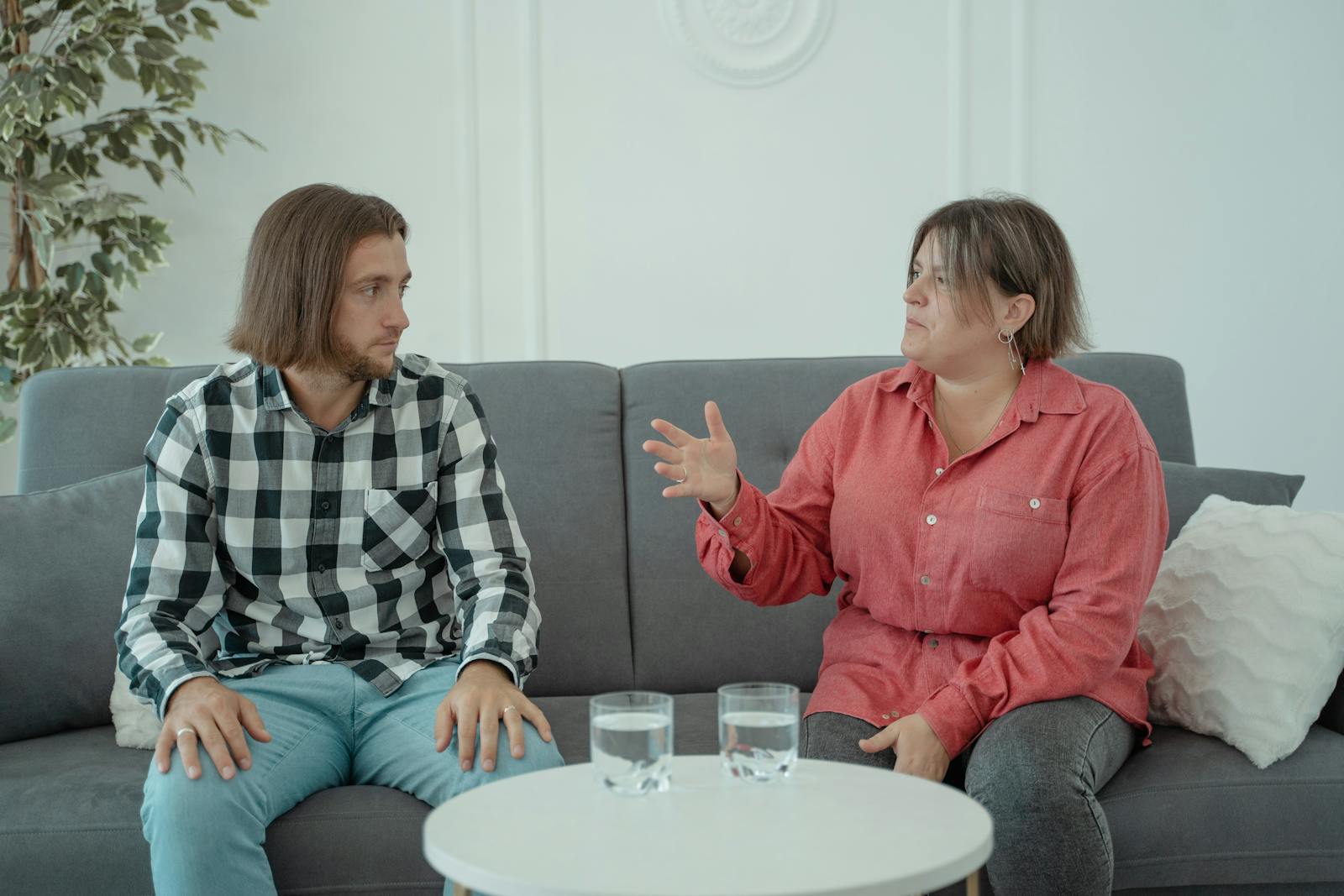
Feature image by Tima Miroshnichenko on Pexels