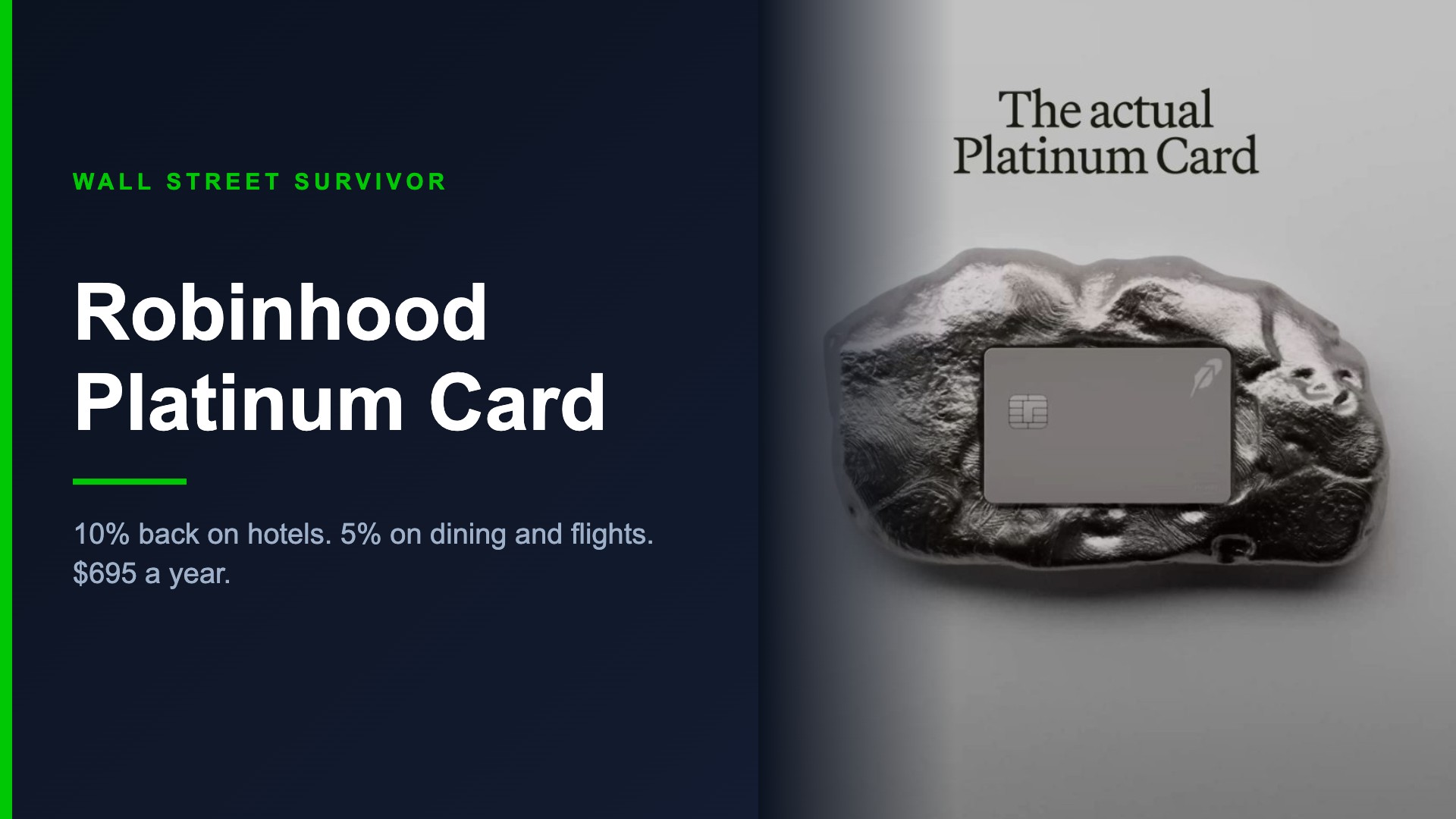
Robinhood spent a decade being the app that made trading feel like a video game. Now it wants a slot in your wallet next to the metal cards people actually put on the table. The Robinhood Platinum Card is a 27-gram, 99.9% platinum-plated Visa Infinite with a $695 annual fee, an invitation-only application, and a rewards structure that is genuinely unusual: 10% cash back on hotels and rental cars, 5% on dining and flights, and 1% on everything else.
That top rate is not a typo, and it is roughly double what the premium travel cards it competes with will pay you. The catch is that the headline rates only apply when you book inside the Robinhood app, and the $695 posts to your statement whether or not you touch the credits stacked behind it. The Consumer Financial Protection Bureau makes the same point about every premium card: a rewards rate only means something after you subtract what you paid to hold the card.
What You Get
U.S. stocks, ETFs, options, and cryptos — all commission-free
Excellent for beginners and advanced investors
Cash management account and credit card
Upgrade to Gold for better rates on cash, margin, and a 3% IRA contribution match
So here is the honest version — what the Platinum Card actually pays, where the “$3,000+ in annual value” comes from, who gets an invitation, and whether the fee pencils out for a normal person.
One thing worth knowing up front: you need a Robinhood brokerage account to redeem Platinum Card cash back. That account is free, and Robinhood is currently giving new users a free stock just for opening one.
Open a Robinhood Account and Get a Free Stock Worth $5 to $200
What Is the Robinhood Platinum Card?
The Robinhood Platinum Card is a Visa Infinite credit card offered by Robinhood Credit, Inc. and issued by Coastal Community Bank. It sits one tier above the Robinhood Gold Card and is aimed squarely at the premium travel card market — the tier occupied by cards with three-figure annual fees and lounge access.
The physical card is the part Robinhood clearly enjoyed building. It is plated in 99.9% pure platinum and weighs 27 grams, which makes it one of the heaviest cards in circulation. Primary cardholders get the platinum-plated version at no extra cost; additional cardholders receive a stainless steel card and can pay to upgrade.
Annual fee: $695
Network: Visa Infinite
Availability: Invitation only — you request access and Robinhood decides
Included: A complimentary Robinhood Gold membership
Requirement: A Robinhood Financial brokerage account is needed to redeem cash back
As of publication, Robinhood lists the card as coming soon and is taking access requests rather than live applications. Individual credit limits vary by applicant and are subject to credit approval and underwriting. Robinhood says you can see whether you are approved without an impact to your credit score, and that your credit is only affected if you decide to accept the offer.
Robinhood Platinum Card Rewards: 10%, 5%, and 1% Cash Back
The earn structure is where this card separates itself from the pack. Most premium travel cards top out at 5x on a narrow booking channel. The Platinum Card doubles that on its best category.
Two conditions matter more than the rates themselves. First, the 10% and 5% travel rates require booking through Robinhood’s in-app travel portal. Robinhood states that prices are passed through from its booking partner with no markup or added margin, which is the right thing to promise — portal bookings on rival cards are frequently more expensive than booking direct, which quietly eats the bonus.
Second, cash back is redeemed through a Robinhood Financial brokerage account. That is the whole design of the Robinhood card ecosystem: rewards land somewhere you can invest them rather than in a points program you have to babysit. If you do not have a brokerage account, the rewards have nowhere to go.
Get Your Free Stock Worth Up to $200 — Robinhood Sign-Up Bonus
Where the $3,000+ in Annual Value Comes From
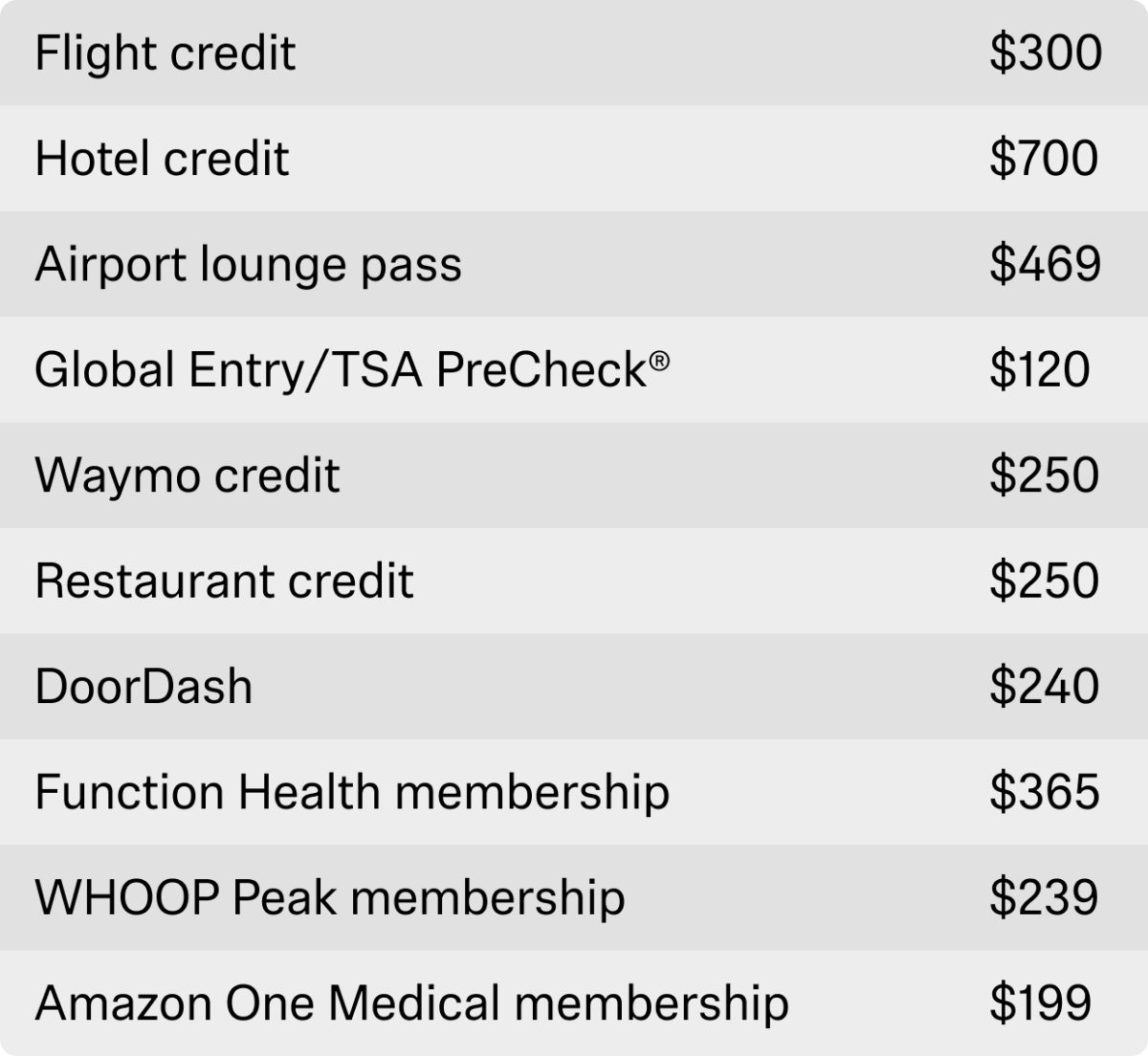
Robinhood advertises “over $3,000 in value every year.” That figure is built from stacked credits and complimentary memberships, not from cash back. It is worth taking apart, because most of these credits are allotted monthly — you cannot save them up and spend them in one December splurge.
Dining: $490 in Annual Restaurant and Delivery Credits
$250 annual credit at 15,000+ eligible restaurants
$120 annual DoorDash promotion with no order minimum
$120 complimentary DashPass membership
These sit on top of the 5% dining cash back, so a heavy restaurant spender gets paid twice. The credits are allotted monthly, which in practice means roughly $21 a month at restaurants and $10 a month at DoorDash — useful if you eat out weekly, largely wasted if you do not.
Travel: Flight Credits, Global Entry, and No Foreign Transaction Fees

$300 annual flight credit — a $150 statement credit every six months, whether you book in the app or directly with the airline
No foreign transaction fees anywhere in the world
Global Entry or TSA PreCheck credit — a $120 value
Travel protection including auto rental coverage, trip cancellation insurance, and travel accident insurance
Dedicated rebooking support when a trip falls apart
The flight credit is the most flexible benefit on the card, because it does not force you into the Robinhood portal. Book directly with the airline and the $150 still applies.
Airport Lounges: Unlimited Priority Pass Access

Cardholders get unlimited access to more than 1,400 Priority Pass lounges worldwide. This is table stakes for a $695 card rather than a differentiator, but the “unlimited” part matters — several competing cards cap visits or charge for guests.
Hotels: $700 in Annual Credits and Elite-Style Treatment
Hotels are where the card is trying hardest. On top of the 10% cash back on in-app hotel bookings, you get up to $250 in hotel credits every six months, plus $100 in on-property credit for each stay booked through Robinhood’s network of 1,700+ premium hotels.
Bookings in that network also come with the perks that normally require chain elite status:
Early check-in, when available
Daily breakfast for two
Room upgrade, when available
Priority late check-out
Health and Wellness: WHOOP, Function Health, and One Medical
This is the category no other premium card is really contesting, and it is where a big chunk of the “$3,000+” number lives:
Complimentary WHOOP Peak membership with hardware included — a $239 per year value
Function Health membership — 160+ advanced lab tests and clinician insights, a $365 value
Amazon One Medical — 24/7 on-demand virtual care, a $199 membership at no cost
Eight Sleep credit — up to a $1,000 one-time credit toward the Pod and Base
Be careful with that Eight Sleep number. It is a one-time credit with a stated expiry, not a recurring annual benefit, and it only pays out if you were already planning to buy a mattress cover that costs more than the card’s fee. Counting it toward an annual value figure flatters the total.
Waymo Credits and a Text-Message Concierge

There is a $250 annual credit on Waymo rides, again allotted monthly, which is a genuinely fun benefit if you live in a city Waymo serves and completely worthless if you do not. Separately, cardholders get a concierge they reach by text for event access, private flights, and the general category of things concierges are for.
Robinhood Platinum Card vs. Robinhood Gold Card
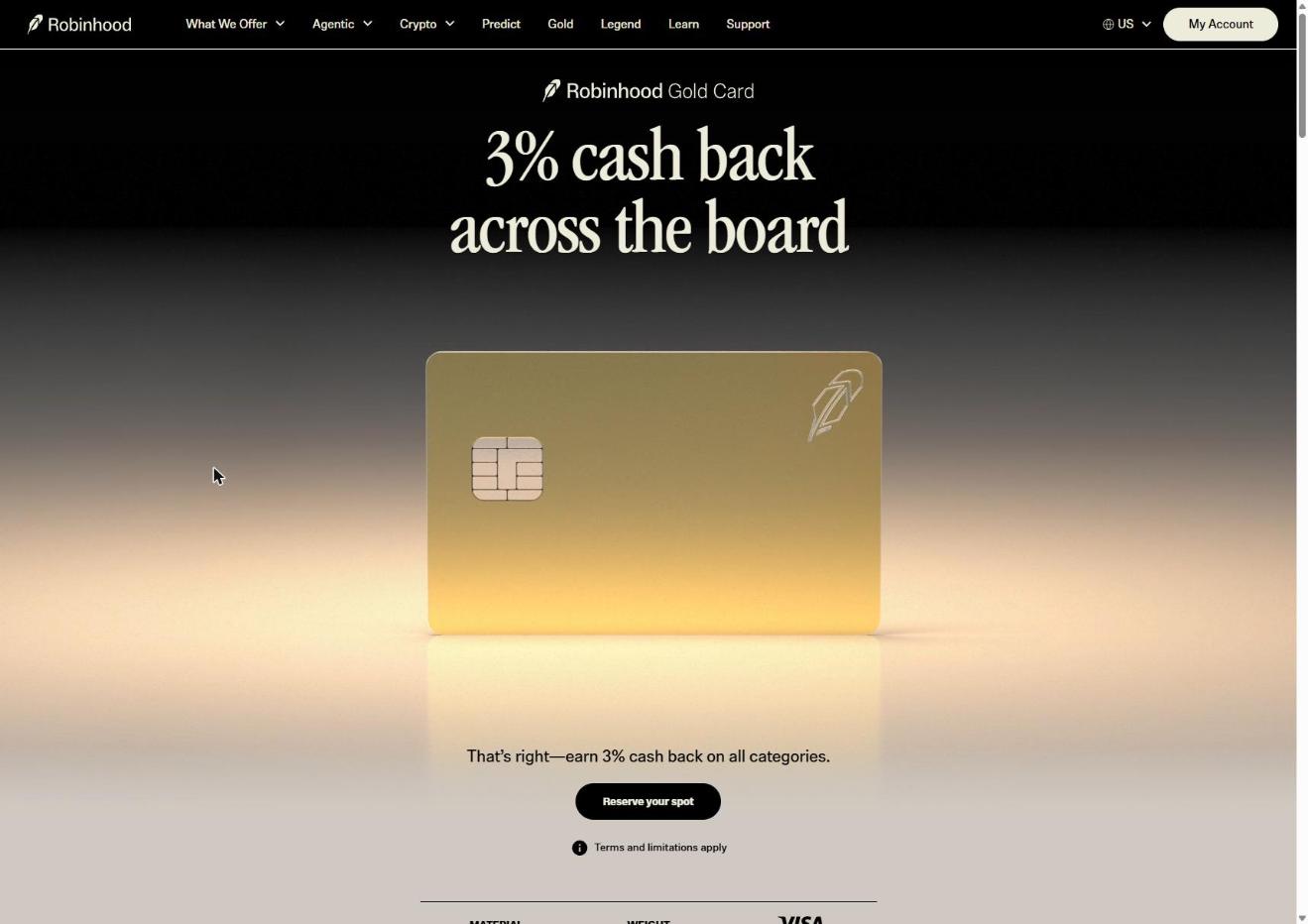
Most people reading this should honestly be comparing the Platinum Card to its cheaper sibling rather than to a competitor.
The Gold Card’s flat 3% is the better deal for most spending profiles, and it is very hard to beat when your spending is spread across groceries, gas, and bills. The Platinum Card only wins if a large share of your spending is concentrated in travel and dining and you will actually use the monthly credits.
Is the $695 Annual Fee Worth It?
Run the arithmetic on the credits alone, ignoring cash back entirely:
On paper the card clears its own fee almost three times over. In practice, that only holds if you are the exact customer Robinhood designed it for: someone who eats out most weeks, flies several times a year, stays in the kind of hotels that appear in a premium booking portal, and lives in a Waymo city.
Strip out the benefits a given person will not use and the picture changes fast. Skip the hotel portal and $700 evaporates. Skip Waymo and there goes another $250. Two deletions and the $695 fee is suddenly a real cost rather than a rounding error.
There is also an opportunity-cost angle that Robinhood, to its credit, has built the whole product around: your cash back lands in a brokerage account where it can be invested rather than sitting in a points ledger. If you are new to that side of the platform, our guide to the Robinhood Free Stock promotion covers how the sign-up bonus works and what you can actually do with it.
Verdict: if you travel often and eat out constantly, the credits alone justify the fee. If your spending is ordinary, the Robinhood Gold Card’s flat 3% will quietly beat it every year.
How to Get the Robinhood Platinum Card
The Platinum Card is invitation only. There is no open application — you request access through Robinhood and wait to be invited. Approval is subject to credit approval and underwriting, and individual credit limits vary by applicant.
Open a Robinhood brokerage account. You need one to redeem cash back, and new accounts currently come with a free stock.
Request access to the Platinum Card through Robinhood.
Wait for an invitation. Robinhood checks approval with no impact to your credit score; your credit is only affected if you accept the offer.
Consider the Gold Card in the meantime if you want 3% back without a $695 commitment.
Start With a Free Stock Worth $5 to $200 — Open a Robinhood Account
Robinhood Platinum Card Pros and Cons
Pros
10% cash back on hotels and rental cars is the highest travel rate on any mainstream card
Over $1,500 in annual statement credits before you count wellness memberships
Unlimited Priority Pass lounge access with no visit cap
No foreign transaction fees
Cash back is redeemed into a brokerage account, so it can be invested
Complimentary Robinhood Gold membership is bundled in
Credit limits up to 5x higher than the Gold Card
Cons
$695 annual fee is charged whether or not you use the credits
The best rates require booking inside the Robinhood app
Credits are allotted monthly, so unused value disappears each month
The advertised “$3,000+ in value” leans on one-time and niche perks
Invitation only, with no published approval criteria
Waymo credits are worthless outside Waymo service areas
You must hold a Robinhood brokerage account to redeem rewards
The Bottom Line
The Robinhood Platinum Card is a serious entry in the premium card market, not a novelty. The 10% hotel rate is real, the credit stack genuinely exceeds the fee, and routing rewards into a brokerage account is a smarter default than another points program.
But it is a card built for a specific life — frequent travel, frequent restaurants, a big city. If that is not your life, the Robinhood Gold Card’s flat 3% with no annual fee is the better call, and you can always upgrade later. Either way, the brokerage account comes first, since that is where every dollar of cash back has to land.
Open a Robinhood Account and Claim Your Free Stock (Worth $5 to $200)
Robinhood Platinum Card FAQs
The Robinhood Platinum Card has a $695 annual fee. Robinhood advertises over $3,000 in annual value from statement credits and complimentary memberships, though much of that only pays out if you use the travel, dining, and wellness benefits.
The card is invitation only. You request access through Robinhood rather than submitting an open application. Approval is subject to credit approval and underwriting, and Robinhood says checking approval does not impact your credit score unless you accept the offer.
It pays 10% cash back on hotels and rental cars, 5% on dining and flights, and 1% on all other purchases. The 10% and 5% travel rates require booking through the Robinhood app.
Yes. You need a Robinhood Financial brokerage account to redeem Platinum Card cash back. Opening one is free, and Robinhood currently gives new users a free stock worth between $5 and $200.
It depends on your spending. The Gold Card pays a flat 3% on everything with no annual fee beyond a Robinhood Gold subscription. The Platinum Card only comes out ahead if a large share of your spending is travel and dining and you use its monthly credits.
As of publication Robinhood lists the card as coming soon and is accepting access requests rather than live applications.