No Result
View All Result
  • Login
Wednesday, August 5, 2026
theadvisertimes.com
  • Home
  • Business
  • Financial Planning
  • Personal Finance
  • Investing
  • Money
  • Economy
  • Markets
  • Stocks
  • Trading
  • Home
  • Business
  • Financial Planning
  • Personal Finance
  • Investing
  • Money
  • Economy
  • Markets
  • Stocks
  • Trading
No Result
View All Result
theadvisertimes.com
No Result
View All Result
Home Cryptocurrency

Banks are lobbying to kill crypto rewards to protect a hidden $1,400 “tax” on every household

by theadvisertimes.com
7 months ago
in Cryptocurrency
Reading Time: 8 mins read
A A
0
Banks are lobbying to kill crypto rewards to protect a hidden ,400 “tax” on every household
Share on FacebookShare on TwitterShare on LInkedIn


Banks are fighting stablecoin rewards to protect a secret $360 billion revenue machine.

When Coinbase chief policy officer Faryar Shirzad posted a thread on Jan. 8 warning that stablecoin rewards “remain under debate” as Congress marks up market structure legislation, he attached numbers that banking groups would rather keep quiet.

US banks earn $176 billion annually on roughly $3 trillion they park at the Federal Reserve, and they collect another $187 billion from card swipe fees, nearly $1,400 per household.

That’s over $360 billion in revenue from payments and deposits alone, and stablecoins with competitive yields threaten both streams at once.

The GENIUS Act, signed in July 2025, bans stablecoin issuers from paying interest or yield “directly or indirectly.” Yet, exchanges route rewards through affiliate programs, treating them as loyalty incentives rather than interest.

Banking groups call this a loophole. The American Bankers Association, joined by 52 state banking associations, sent a letter to Congress on Jan. 6 urging lawmakers to extend the ban to “all affiliated entities and partners.”

The numbers tell a different story about who actually benefits from the current arrangement.

Trump signs GENIUS Act into law, activating America's first regulatory framework for stablecoins
Related Reading

Trump signs GENIUS Act into law, activating America’s first regulatory framework for stablecoins

In addition to sign the stablecoin framework into law, Trump vowed to approve the market structure bill next.

Jul 18, 2025 · Gino Matos

Hidden subsidy

Banks hold reserve balances with the Federal Reserve totaling $2.9 trillion as of December 2025.

The Fed paid $176.8 billion in interest on those reserves in 2023, gross income to banks before their own funding costs. Reserve balances existed in trivial amounts before 2008.

Bank reserve balances with the Fed
Reserve balances held at Federal Reserve Banks jumped from near zero before 2008 to $2.9 trillion by late 2025.

The Fed’s adoption of an “ample reserves” framework after quantitative easing created a permanent pool of interest-earning deposits that banks can hold with zero credit risk.

The Fed’s December 2025 decision to begin purchasing Treasury bills signals that reserve balances won’t shrink much further.

If stablecoins offer competitive yields funded by the same Treasury securities that back reserves, they create a parallel system where users can earn similar returns without routing dollars through bank balance sheets.

That doesn’t eliminate bank lending capacity, as stablecoin issuers hold reserves in Treasury bills and bank deposits, but it shifts who captures the spread.

The $187 billion toll booth

US card payments processed $11.9 trillion in purchase volume in 2024, and merchants paid $187.2 billion in acceptance and processing fees. This implies a cost of about 1.57% per $100 of spending.

Nilson Research shows that the eight largest issuers account for 90.8% of Visa, Mastercard, and American Express purchase transactions. Community banks hold a minor share of this revenue pool.

Debit interchange alone generated $34.1 billion in 2023, with network fees adding another $12.95 billion. Credit card interchange is substantially higher.

Stablecoins bypass this infrastructure, since on-chain payments cost a fraction of card network fees. If stablecoins capture even 5% of card purchase volume, which is roughly $595 billion at current fee rates, that represents $9.3 billion in annual merchant savings.

For banks, it’s $9.3 billion in foregone revenue, which doubles to $18.6 billion at 10%.

Fee vs payment shareFee vs payment share
Stablecoins capturing 5% of card purchase volume would displace $9.4 billion in merchant fees, rising to $18.7 billion at 10% market share.

Stablecoin transaction value hit $33 trillion in 2025, according to Artemis, which makes the competitive threat beyond hypothetical. That’s roughly three times the US card purchase volume.

Most of those transactions occur within crypto markets, but the infrastructure already handles payment flows at scale.

Stablecoins just eclipsed Bitcoin in the one metric that matters, exposing a $23 trillion global fault lineStablecoins just eclipsed Bitcoin in the one metric that matters, exposing a $23 trillion global fault line
Related Reading

Stablecoins just eclipsed Bitcoin in the one metric that matters, exposing a $23 trillion global fault line

Cross-border flows have finally overtaken Ethereum, proving these tokens are no longer just for crypto gambling.

Dec 8, 2025 · Oluwapelumi Adejumo

Banking groups frame their opposition as a prudential concern, warning that deposit flight will impair lending.

Charles River Associates, in research commissioned by Coinbase, tested this using monthly data from 2019 to 2025 and found no statistically significant relationship between USDC growth and community bank deposits.

Even under harsh assumptions, community banks would lose less than 1% of deposits in a baseline scenario and 6.8% in an extreme case.

BC GameBC Game

Cornell researchers reached a similar conclusion: rewards would need to approach 6% to affect deposits meaningfully. Current programs range from 1% to 3% and are funded by Treasury bill yields.

That’s competitive with high-yield savings but not transformative enough to trigger mass deposit migration.

Reserve budget scales mechanically

Stablecoins generate yield passively, since issuers hold reserves in Treasury bills yielding 3% to 5%. If platforms pass through half of that yield as rewards, the payout pool scales directly with outstanding stablecoin supply.

At today’s market cap of roughly $307.6 billion, a 1.5% to 2.5% reward rate implies annual user payments of $4.6 billion to $7.7 billion across the industry. If stablecoin supply grows to $1 trillion, the same math produces $15 billion to $25 billion annually.

Rewards poolRewards pool
At $1 trillion stablecoin supply, annual rewards would reach $15 billion to $25 billion depending on the payout rate offered to users.
The $308B question: Will stablecoins thrive globally without China?The $308B question: Will stablecoins thrive globally without China?
Related Reading

The $308B question: Will stablecoins thrive globally without China?

Despite China’s criticism, stablecoins find product-market fit, challenging traditional finance with $46 trillion in transactions.

Oct 30, 2025 · Oluwapelumi Adejumo

That kind of distribution competes with both low-yield checking balances and credit card rewards programs, ultimately funded by merchant fees.

Bank incentives become clearer when framed as a defense of margin.

The $176 billion in reserve balance interest and $187 billion in card fees represent revenue streams that require no lending risk. Reserve balances earn a spread over what banks pay depositors, and card fees extract value from every purchase.

Stablecoins compress both margins by introducing competition at the payment layer and offering users a direct claim on Treasury yields.

The policy fight isn’t about whether stablecoins reduce lending capacity. It’s about whether incumbents can lock in a regulatory advantage that prevents stablecoins from functioning as substitutes for transaction accounts.

What GENIUS actually prohibits

The GENIUS Act makes it unlawful for a payment stablecoin issuer to pay interest “directly or indirectly,” explicitly including arrangements through affiliates.

Banking groups argue that exchange-based reward programs violate this provision. Crypto platforms counter that the statute targets issuers, not intermediaries.

The Bank Policy Institute wants clarifying language in market structure legislation to ensure “rewards routed via affiliates” are treated as prohibited yield.

The $6.6 trillion nightmare scenario that has Senate Democrats trying to kill stablecoin yield immediatelyThe $6.6 trillion nightmare scenario that has Senate Democrats trying to kill stablecoin yield immediately
Related Reading

The $6.6 trillion nightmare scenario that has Senate Democrats trying to kill stablecoin yield immediately

Stablecoin yield question stalls crypto legislation as lawmakers weigh impact on community lending and regulation.

Dec 11, 2025 · Oluwapelumi Adejumo

That position reveals the strategy: prevent stablecoins from becoming an alternative to interest-bearing accounts by any means. If successful, stablecoin holders receive no compensation for the value their deposits create, even as banks earn 3% to 5% on reserve balances.

Competitive endgame

Fed researchers note that stablecoins can “reduce, recycle, or restructure” deposits. Banks want the restructuring on their terms: forbid stablecoin rewards while offering bank-issued tokenized deposits that keep balances inside the regulated perimeter.

Users get on-chain dollars. Banks keep the deposits and the spread.

However, stablecoin platforms have a different theory. If the yield ban applies only to issuers, exchanges can compete through affiliate revenue, lending returns, or trading fees. That keeps stablecoins attractive without requiring issuers to pay interest directly.

China announced it will pay interest on the digital yuan, explicitly competing with dollar-denominated stablecoins. If US policy bans rewards while foreign digital currencies offer yields, the competitive implication becomes a national security concern.

Pro-crypto lawyer John Deaton called a US reward ban “a national security trap.”

Congress decides whether to interpret GENIUS narrowly, applying it only to issuers, or broadly, extending it to affiliates and platforms.

The narrow interpretation preserves competition. The broad interpretation protects incumbent margins.

Banking groups frame this as a fight about deposit stability. The numbers show it’s a fight about $360 billion in revenue and whether stablecoins get a chance to compete for it.

Mentioned in this article


Source link

Tags: banksCryptoHiddenhouseholdKilllobbyingProtectRewardstax
ShareTweetShare
Previous Post

Here’s Why $99K Might Be The Next Crucial Level To Watch

Next Post

NuScale Power Is Interesting, but Here’s What I’d Buy Instead

Related Posts

Sen. Cynthia Lummis Says Clarity Act Talks With Democrats Continue Daily

Sen. Cynthia Lummis Says Clarity Act Talks With Democrats Continue Daily

by theadvisertimes.com
August 5, 2026
0

The CLARITY Act remained in focus after Senator Cynthia Lummis said negotiations with Democrats are continuing daily, while Senate leaders...

Other revenue outlook: Circle’s B USDC flow gap

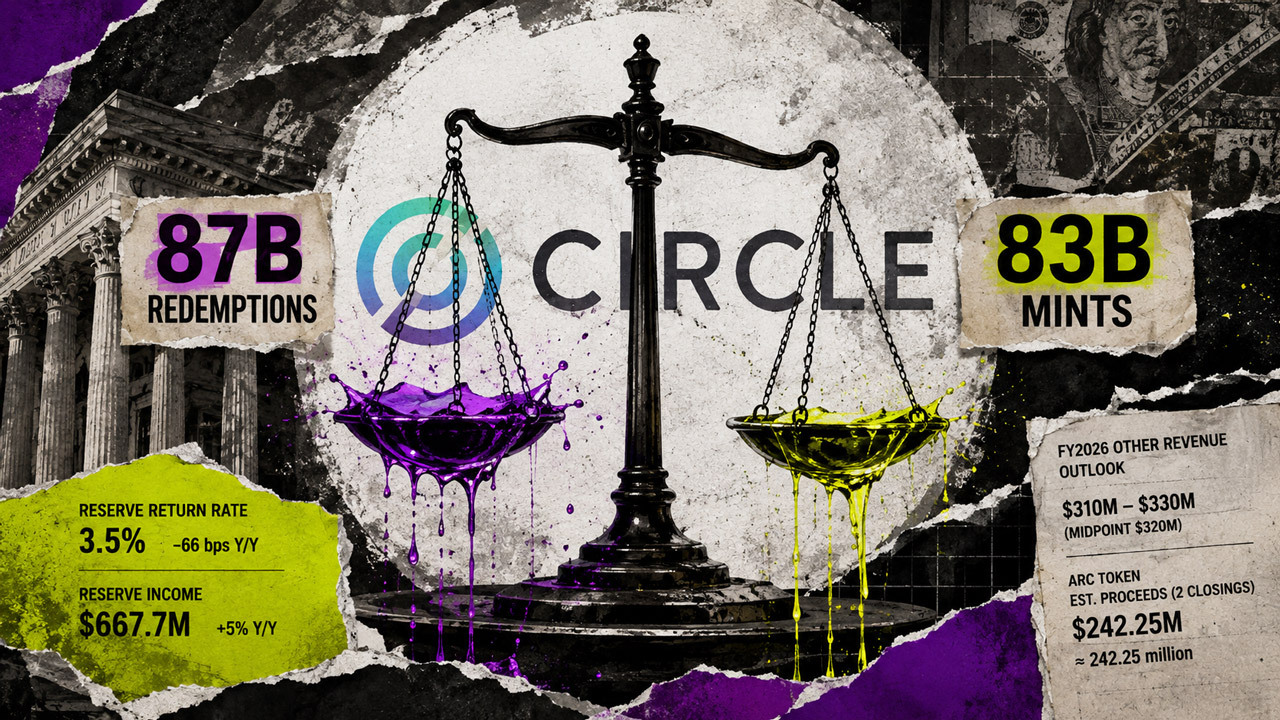
Other revenue outlook: Circle’s $4B USDC flow gap

by theadvisertimes.com
August 5, 2026
0

Circle’s reserve engine absorbed a tough second quarter. Gross USDC redemptions exceeded mints by about $4 billion, and reserve yield...

Democrats Move to Block CLARITY Act Due to Stalled Ethics Talks

Democrats Move to Block CLARITY Act Due to Stalled Ethics Talks

by theadvisertimes.com
August 5, 2026
0

Key TakeawaysPunchbowl News has reported that Democrats will block cloture, citing stalled White House ethics talks.Sen. Ruben Gallego said Republicans...

Ethereum Proposal to Slash Staking Rewards Sparks Backlash

Ethereum Proposal to Slash Staking Rewards Sparks Backlash

by theadvisertimes.com
August 4, 2026
0

A group of six Ethereum researchers and developers, including Ethereum Foundation’s Justin Drake, has proposed changing the network’s issuance policy...

Elon Musk SpaceX Expands AI Partnership With NVIDIA, Stocks Gain

Elon Musk SpaceX Expands AI Partnership With NVIDIA, Stocks Gain

by theadvisertimes.com
August 4, 2026
0

SpaceX, the rocket company led by Elon Musk, has tapped NVIDIA to provide the company’s new Starmind AI satellite network...

Bybit Splits Crypto and Payments Into Two Austrian Entities. Bybit.eu Will Run Both Under One Login

Bybit Splits Crypto and Payments Into Two Austrian Entities. Bybit.eu Will Run Both Under One Login

by theadvisertimes.com
August 4, 2026
0

Bybit Payments GmbH has been granted an electronic money institution licence in Austria, giving Bybit a second regulated entity alongside...

Next Post
NuScale Power Is Interesting, but Here’s What I’d Buy Instead

NuScale Power Is Interesting, but Here's What I'd Buy Instead

How to Get Free Samples

How to Get Free Samples

  • Trending
  • Comments
  • Latest
SEC pushes private market access, but retail is already in

SEC pushes private market access, but retail is already in

July 16, 2026
How I Maximize My Sapphire Reserve Dining Credit

How I Maximize My Sapphire Reserve Dining Credit

July 10, 2026
The Weekly Notable Startup Funding Report: 6/22/26 – AlleyWatch

The Weekly Notable Startup Funding Report: 6/22/26 – AlleyWatch

June 21, 2026
The 10 Largest NYC Tech Startup Funding Rounds of June 2026 – AlleyWatch

The 10 Largest NYC Tech Startup Funding Rounds of June 2026 – AlleyWatch

July 6, 2026
The Weekly Notable Startup Funding Report: 7/20/26 – AlleyWatch

The Weekly Notable Startup Funding Report: 7/20/26 – AlleyWatch

July 20, 2026
*HOT* Ninja Nutri-Blender Pro with 2 Single-Serve Cups only .99 shipped (Reg. 0!)

*HOT* Ninja Nutri-Blender Pro with 2 Single-Serve Cups only $49.99 shipped (Reg. $110!)

July 4, 2026
SpaceX created a new class of ultrawealthy. Here’s what comes next

SpaceX created a new class of ultrawealthy. Here’s what comes next

0
Adults Over 50: Ask These Vaccine Questions Before Cold and Flu Season

Adults Over 50: Ask These Vaccine Questions Before Cold and Flu Season

0
Clicks and Credibility 2.0 | RPC

Clicks and Credibility 2.0 | RPC

0
El-Sayed on Track to Win US Senate Primary, Overcoming AIPAC’s  Million Onslaught

El-Sayed on Track to Win US Senate Primary, Overcoming AIPAC’s $30 Million Onslaught

0
Stopgap Spending and Confirmation for Blanche? The Senate Slogs On

Stopgap Spending and Confirmation for Blanche? The Senate Slogs On

0
How to Build Your Own Real Estate Investing Team (From Scratch)

How to Build Your Own Real Estate Investing Team (From Scratch)

0
SpaceX created a new class of ultrawealthy. Here’s what comes next

SpaceX created a new class of ultrawealthy. Here’s what comes next

August 5, 2026
Highlights of McKesson’s (MCK) Q1 2027 earnings report

Highlights of McKesson’s (MCK) Q1 2027 earnings report

August 5, 2026
Sen. Cynthia Lummis Says Clarity Act Talks With Democrats Continue Daily

Sen. Cynthia Lummis Says Clarity Act Talks With Democrats Continue Daily

August 5, 2026
3 types of social capital behind financial advisor success

3 types of social capital behind financial advisor success

August 5, 2026
Other revenue outlook: Circle’s B USDC flow gap

Other revenue outlook: Circle’s $4B USDC flow gap

August 5, 2026
SpaceX draws retail investors despite fall in shares post earnings

SpaceX draws retail investors despite fall in shares post earnings

August 5, 2026
theadvisertimes.com

Get the latest news and follow the coverage of Business & Financial News, Stock Market Updates, Analysis, and more from the trusted sources.

CATEGORIES

  • Business
  • Cryptocurrency
  • Economy
  • Financial Planning
  • Investing
  • Market Analysis
  • Markets
  • Money
  • Personal Finance
  • Startups
  • Stock Market
  • Trading

LATEST UPDATES

  • SpaceX created a new class of ultrawealthy. Here’s what comes next
  • Highlights of McKesson’s (MCK) Q1 2027 earnings report
  • Sen. Cynthia Lummis Says Clarity Act Talks With Democrats Continue Daily
  • Our Great Privacy Policy
  • Terms of Use, Legal Notices & Disclosures
  • About Us
  • Contact Us

© Copyright 2024 All Rights Reserved
See articles for original source and related links to external sites.

Welcome Back!

Login to your account below

Forgotten Password?

Retrieve your password

Please enter your username or email address to reset your password.

Log In
No Result
View All Result
  • Home
  • Business
  • Financial Planning
  • Personal Finance
  • Investing
  • Money
  • Economy
  • Markets
  • Stocks
  • Trading

© Copyright 2024 All Rights Reserved
See articles for original source and related links to external sites.