“Much of Book 3 is dedicated to a historical account of how and why the feudal order that prevailed throughout Europe for many centuries eventually gave way to a liberal, commercial order—that is, how a world dominated by hierarchy, dependence, and intrastate conflict was superseded by one in which the rule of law reigned and people enjoyed comparative freedom and safety. Smith’s account of how the feudal lords squandered their immense power for the sake of frivolous luxuries has become a famous one.”
Much of Book 3 is dedicated to a historical account of how and why the feudal order that prevailed throughout Europe for many centuries eventually gave way to a liberal, commercial order—that is, how a world dominated by hierarchy, dependence, and intrastate conflict was superseded by one in which the rule of law reigned and people enjoyed comparative freedom and safety. Smith’s account of how the feudal lords squandered their immense power for the sake of frivolous luxuries has become a famous one.
After the fall of the Roman empire, Smith recounts, the great landowners throughout Europe possessed huge estates over which they exercised almost complete control, because the kings’ authority was rarely strong enough to challenge them on a local level. Given the relative absence of luxuries and manufactured goods in these societies, the lords had little use for their wealth other than to “maintain” thousands of serfs, who in turn became utterly dependent on their patrons for sustenance, accommodation, and protection: “Every great landlord was a sort of petty prince. His tenants were his subjects. He was their judge, and in some respects their legislator in peace, and their leader in war. He made war at his own discretion, frequently against his neighbours, and sometimes against his sovereign” (WN III.ii.3; see also III.iv.7). Smith forcefully draws the reader’s attention to the serfs’ almost total lack of personal freedom: they could have no private property that was free from encroachment by their lord, they were bought and sold with the land and so were unable to move freely, they typically could not choose their own occupations, and they often had to obtain their lord’s consent to get married. In all, they were little better than slaves (see WN III.ii.8).
“Once the people were no longer dependent on the lords, they not only enjoyed greater security—because the rule of law was enforced by the king—but also greater freedom or discretion, such as the choice of where to live and what occupation to practice. It was only after people gained this kind of freedom of choice, Smith says, that they ‘became really free in our present sense of the word Freedom’”
The kings struggled for centuries to limit the power of the lords without success, Smith writes, “but what all the violence of the feudal institutions could never have effected, the silent and insensible operation of foreign commerce and manufactures gradually brought about.” Once commerce expanded and luxuries were introduced, the lords finally had something on which to spend their wealth other than maintaining their serfs. These goods gave them a way to spend their money on themselves alone, one that they immediately adopted out of greed and vanity. Thus, “for a pair of diamond buckles perhaps, or for something as frivolous and useless, they exchanged the maintenance, or what is the same thing, the price of the maintenance of a thousand men for a year, and with it the whole weight and authority which it could give them” (WN III.iv.10).
After the lords began to spend the bulk of their wealth on luxuries, in other words, they could no longer afford to keep their dependents. And after the serfs were dismissed, Smith writes, “the great proprietors were no longer capable of interrupting the regular execution of justice, or of disturbing the peace of the country. Having sold their birth-right, not like Esau for a mess of pottage in a time of hunger and necessity, but in the wantonness of plenty, for trinkets and baubles, fitter to be the play-things of children than the serious pursuits of men, they became as insignificant as any substantial burgher or tradesman in a city” (WN III.iv.15). The fall of the lords resulted in an enormous increase in the power of the kings—as happened in Britain under the Tudors—who were then able to establish what Smith calls a “regular government,” meaning one that was strong enough to effectively enforce order and administer justice throughout the country (WN III.iv.15).
Once the people were no longer dependent on the lords, they not only enjoyed greater security—because the rule of law was enforced by the king—but also greater freedom or discretion, such as the choice of where to live and what occupation to practice. It was only after people gained this kind of freedom of choice, Smith says, that they “became really free in our present sense of the word Freedom” (WN III.iii.5). Hence the upshot of Smith’s story is, to repeat, that commerce helped to introduce “order and good government, and with them, the liberty and security of individuals … who had before lived almost in a continual state of war with their neighbours, and of servile dependency on their superiors” (WN III.iv.4).
Later in The Wealth of Nations, Smith reveals that the social orders that are the focus of Book 3—feudal Europe and the western Europe of his own time—constitute the latter stages of a four-stage process or schema (see WN V.i–ii). He suggests that societies generally progress through hunting, shepherding, agricultural, and commercial stages, and that feudal Europe corresponded to the third, agricultural stage, while western Europe in the eighteenth century corresponded to the final, commercial stage.
Smith’s four-stages schema helps to extend and reinforce the lesson that he derives from the narrative about the fall of the feudal lords in Book 3. The basics can be summarized in the following table:
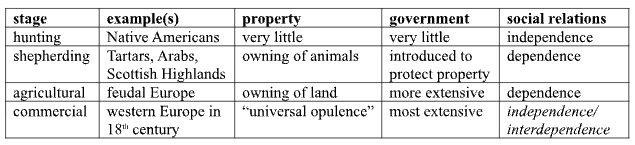
Let’s unpack this a bit. Smith suggests that in the first stage of society, such as that found among many Native American tribes, there is no domestication of animals or raising of crops; people subsist by hunting, fishing, and gathering. Within these societies, there is very little in the way of private property—nothing that “exceeds the value of two or three days labour” (WN V.i.b.2). As a result, there is also little need for “any established government or any regular administration of justice” (WN V.i.b.2).
Given the absence of much economic inequality or government in the hunting stage, Smith notes, individuals generally enjoy a great deal of personal freedom or independence. The cost of this seemingly easy lifestyle, however, is what he describes as “universal poverty” (WN V.i.b.7). On the very first page of the book, he notes that such societies are often “so miserably poor, that, from mere want, they are frequently reduced … to the necessity sometimes of directly destroying, and sometimes of abandoning their infants, their old people, and those afflicted with lingering diseases, to perish with hunger, or to be devoured by wild beasts” (WN intro.4).
Smith’s chief examples of the second, shepherding stage of society are the “Tartars” (meaning the inhabitants of central Asia), Arabs, and Scottish Highlanders. In these societies, subsistence is not quite as precarious as in the hunting stage. Because people own and raise animals, meat and milk are usually readily available. The ownership of herds introduces real economic inequality for the first time, as well as the need for “some degree of … civil government” to protect the property of the better-off (WN V.i.b.12).
Perhaps the key feature of the shepherding stage, however, is the rise of personal dependence. Smith suggests that, given the absence of luxuries and manufactured goods in this stage, the only way for wealthy individuals to use their wealth is to “maintain” or provide for others—sometimes thousands of others—which in turn renders those others utterly dependent on them, much the way that the serfs were dependent on the lords during the feudal era. In fact, Smith writes of the shepherding stage that there is “no period … in which authority and subordination are more perfectly established” (WN V.i.b.7). If the keynote of life in the hunting stage is dire poverty, then the central fact of shepherding life is the rise of subservience among all but the few wealthiest individuals.
“In commercial society, he maintains, the wealthy may enjoy a great deal of purchasing power, but their wealth does not lead to direct authority over others since everyone stands in a market relationship with everyone else and there are generally a multitude of potential buyers, sellers, and employers.”
The third, agricultural stage commences when people begin owning and cultivating the land. Smith’s chief example here is the feudal period in Europe that he describes so painstakingly—and harshly—in Book 3. The ownership of land and the greater economic inequality of this stage result in the need for an even more extensive and complicated government than had been found in the shepherding stage. The problem of dependence from the previous stage, however, very much remains. Property is still a source of great power—although land comes to be more important than herds—and the wealthy still have little on which to spend their wealth other than the maintenance of a large number of dependents (see WN III.iv.5).
We have already seen that Smith regarded the prevalence of “servile dependency” in feudal Europe—dependence that ran so deep that it resembled slavery—as the key obstacle to liberty and security during this era (WN III.iv.4). This is, again, why he saw the rise of commerce and the concomitant fall of the feudal lords as so important.
The fourth and final stage of Smith’s schema, commercial society, emerged in the western Europe of his time as international trade grew more extensive and occupations grew more specialized. These developments led to even greater economic inequality than had existed in the agricultural stage, at least in strictly numerical terms, but the enormous productivity that they unleashed also made possible what Smith describes as “that universal opulence which extends itself to the lowest ranks of the people” (WN I.i.10). As John Locke had famously argued, even the poor in commercial society are materially better off than even the rich in precommercial societies (see WN I.i.11).
Even more importantly, for Smith, in commercial society the problem of personal dependence—the problem that had dominated the shepherding and agricultural stages of society—is greatly mitigated. In commercial society, he maintains, the wealthy may enjoy a great deal of purchasing power, but their wealth does not lead to direct authority over others since everyone stands in a market relationship with everyone else and there are generally a multitude of potential buyers, sellers, and employers (see WN I.v.3; III.iv.11–12; and V.i.b.7).
Of course, the wealthy may support many others indirectly by employing them or by buying goods that they produce, but Smith argues that this indirect support is not enough to place these people at their command. Even if employees are likely to try to please their employers in order to keep their jobs, for example, it is highly unlikely that they would surrender their rights to them or accompany them into battle, the way that the serfs were compelled to do for their lords.
Notice also that, according to Smith, people enjoy greater personal independence in commercial society not despite the fact that the government is even stronger than it had been in earlier stages, but precisely because it is stronger. As the narrative of Book 3 shows, the rise of liberty and security was made possible by the establishment of a “regular government” that was able to effectively enforce order and administer justice throughout the country (WN III.iv.15). So much for the caricature of Smith as a dogmatic opponent of all government.
This is, in my view, the key takeaway from Smith’s four-stages schema: in the society with the most property, the most inequality, and the most government, the independence that had characterized the society with the least property, the least inequality, and the least government reemerges. It is a different kind of independence, and indeed a preferable kind of independence, because it results not from a dearth of property that makes government unnecessary but rather from the effective rule of law and the interdependence of the market. (Hence the final box in the table above, emphasized in italics.) Instead of liberty and security amid “universal poverty,” as in the hunting stage, people enjoy liberty and security along with “universal opulence.” As Smith indicates in the passage whose importance I stressed at the outset, this is the key reason why he defended and promoted commercial society, whatever flaws it may have.
This article has been cross-posted from Liberty Matters, part of the Liberty Fund network. It is part of the series “Compounding Interest: Revisiting the Wealth of Nations at 250“.
Endnotes
[1] I have also called attention to the importance of this passage in Dennis C. Rasmussen, The Problems and Promise of Commercial Society: Adam Smith’s Response to Rousseau (Pennsylvania State University Press, 2008), especially 136–37, but also chapter 4 more generally; and Dennis C. Rasmussen, The Infidel and the Professor: David Hume, Adam Smith, and the Friendship That Shaped Modern Thought (Princeton University Press, 2017), especially 162–65. The next five paragraphs of this essay draw on these earlier discussions, and I am grateful to the publishers for permission to reuse this material.
*Dennis C. Rasmussen is a Professor of Political Science and the Hagerty Family Fellow at Syracuse University’s Maxwell School of Citizenship and Public Affairs, as well as co-director of SU’s Political Philosophy Program.Read more by Dennis Rasmussen.