
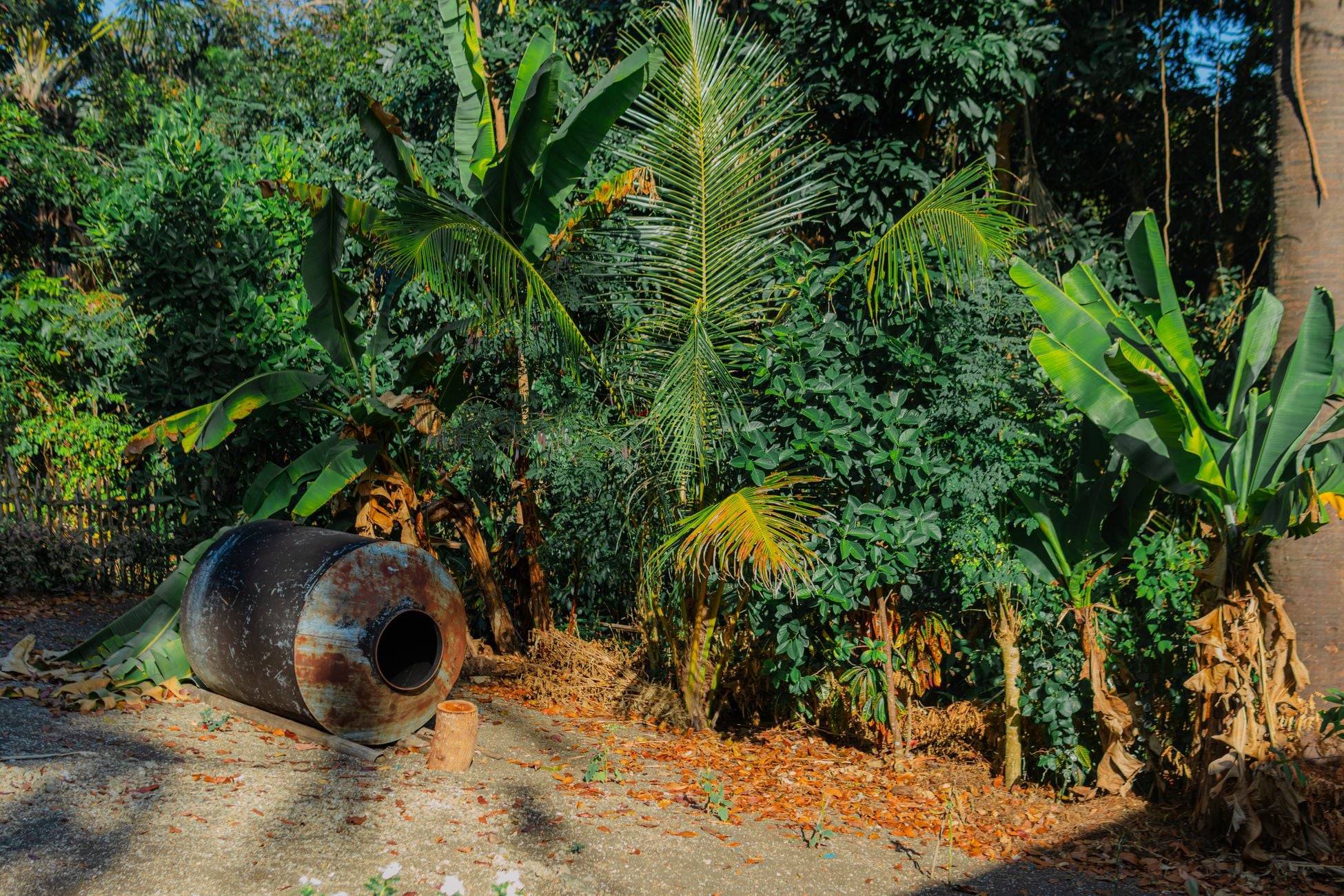
The air inside a mature oil palm plantation is thick and oddly quiet. Sunlight breaks through in narrow slats between the fronds, and the ground beneath the trees is a swept floor of fallen leaves, herbicide-blackened weeds, and the occasional cracked fruit. A worker moves between the trunks with a long aluminium pole tipped by a curved blade, reaching up to cut bunches of red-orange fruit that thud down at his boots. The grid runs in every direction. Nine metres between each tree, then nine more, then nine more, for hectares.
This used to be one of the oldest rainforests on Earth.
Some estimates place Borneo’s rainforest origins deep in the Cretaceous period, around the time dinosaurs still moved through tropical worlds. The Andes, by contrast, reached anything close to their modern height much later, through the long tectonic upheavals of the Cenozoic era. That is the scale of the contrast. An ancient forest system, measured in tens of millions of years, being remade within the span of a few human generations. And in the last forty years, a single cultivated tree, the African oil palm, Elaeis guineensis, has replaced enormous stretches of it.
A forest older than the mountains
The dipterocarps that dominate Borneo’s lowlands are giants. Individual trees can rise above the canopy like living towers, and the family they belong to, Dipterocarpaceae, has been the structural backbone of Southeast Asian rainforest for tens of millions of years. That continuity matters. Unlike the forests of Europe or North America, which were repeatedly scraped back and reshaped by Pleistocene ice sheets, much of Borneo’s tropical forest history belongs to a far older ecological timeline. Its lineages, soils, fungi, birds, mammals, insects, and canopy architecture developed through deep time. That is the system being cleared, in rectangular blocks, for rows of a single tree.
The plantation that replaced it
Oil palm arrived in Southeast Asia from West Africa as an ornamental in the 19th century and became a commercial crop in the 20th. Today Indonesia and Malaysia produce most of the world’s palm oil, and Borneo, split between Indonesian Kalimantan, Malaysian Sabah and Sarawak, and the small sultanate of Brunei, carries a large share of the plantations.
Satellite investigations and environmental reporting have repeatedly shown that clearing for palm oil in Indonesia has continued even after the industry’s No Deforestation, No Peat, No Exploitation pledges became a public standard. The problem is not only direct clearance by a branded company. It is also the way cleared land can move through intermediaries and eventually enter supply chains with its origin blurred.
The substitution is brutally simple. A hectare that once held a dense mix of tree species, birds, mammals, insects, epiphytes, fungi, and canopy layers becomes a hectare of one species, planted in grids roughly nine metres apart, harvested on a short commercial rotation.
What gets lost when the rows go in
Ecologists have documented the same pattern across tropical landscapes: when complex forest becomes simplified agricultural land, the species that remain are usually a smaller, hardier, more generalist subset of what lived there before. The rare, specialised, slow-breeding, canopy-dependent species disappear first.
The pattern is severe in Borneo. Orangutans, clouded leopards, helmeted hornbills, proboscis monkeys, and thousands of plant species depend on intact lowland forest. Oil palm monoculture supports only a fraction of that diversity, mostly generalist animals and insects able to survive in disturbed or simplified habitat.
A 2025 study in Nature on biodiversity loss from outsourced deforestation traced how consumption in wealthy countries drives forest clearing in tropical biomes thousands of kilometres away. The palm oil in a European chocolate bar or a North American detergent is one strand of that global chain.
The orangutan problem
The Bornean orangutan (Pongo pygmaeus) faces critical threats to its survival, with populations dramatically reduced in recent decades. Females give birth infrequently, often only once every six to eight years, one of the slowest reproductive rates among mammals. That means any population loss takes generations to recover from, if it recovers at all.
In March 2026, Mongabay reported that a palm oil firm had cleared more than 3,000 hectares, about 7,500 acres, inside a UNESCO biosphere reserve in Indonesian Borneo, in areas identified as orangutan habitat. The reserve designation, in other words, did not stop the bulldozers.
An adult male orangutan needs a substantial home range of mature forest to feed himself on fruit, bark, leaves, and insects. A plantation grid offers none of that. Animals displaced into adjacent fragments either struggle to find enough food, are killed after entering farms or plantations, or end up in rescue centres such as Sepilok or Nyaru Menteng.
Peat, carbon, and the fires that follow
Borneo’s lowland forest often grows on peat. Waterlogged layers of partially decomposed plant matter, sometimes metres deep, built up over thousands of years. Peat soils store an extraordinary amount of carbon per hectare, more than almost any other terrestrial ecosystem.
To plant oil palm on peat, the land has to be drained. Drained peat dries out, oxidises, and burns. The 2015 Indonesian fire season, fuelled in large part by drained peatlands in Sumatra and Kalimantan, released massive quantities of CO₂, with emissions at peak intensity rivaling those of major industrial economies. The smoke from those fires drifted across Singapore, Malaysia, and southern Thailand, closing schools and grounding flights. Children breathed it for weeks.
► Watch · Eat the World
The Food That Ate the Oldest Rainforest on Earth
Eat the World traces palm oil from the fruit of an African tree to the industry that helped turn Borneo’s ancient rainforest into plantation rows.

The geometry of replacement
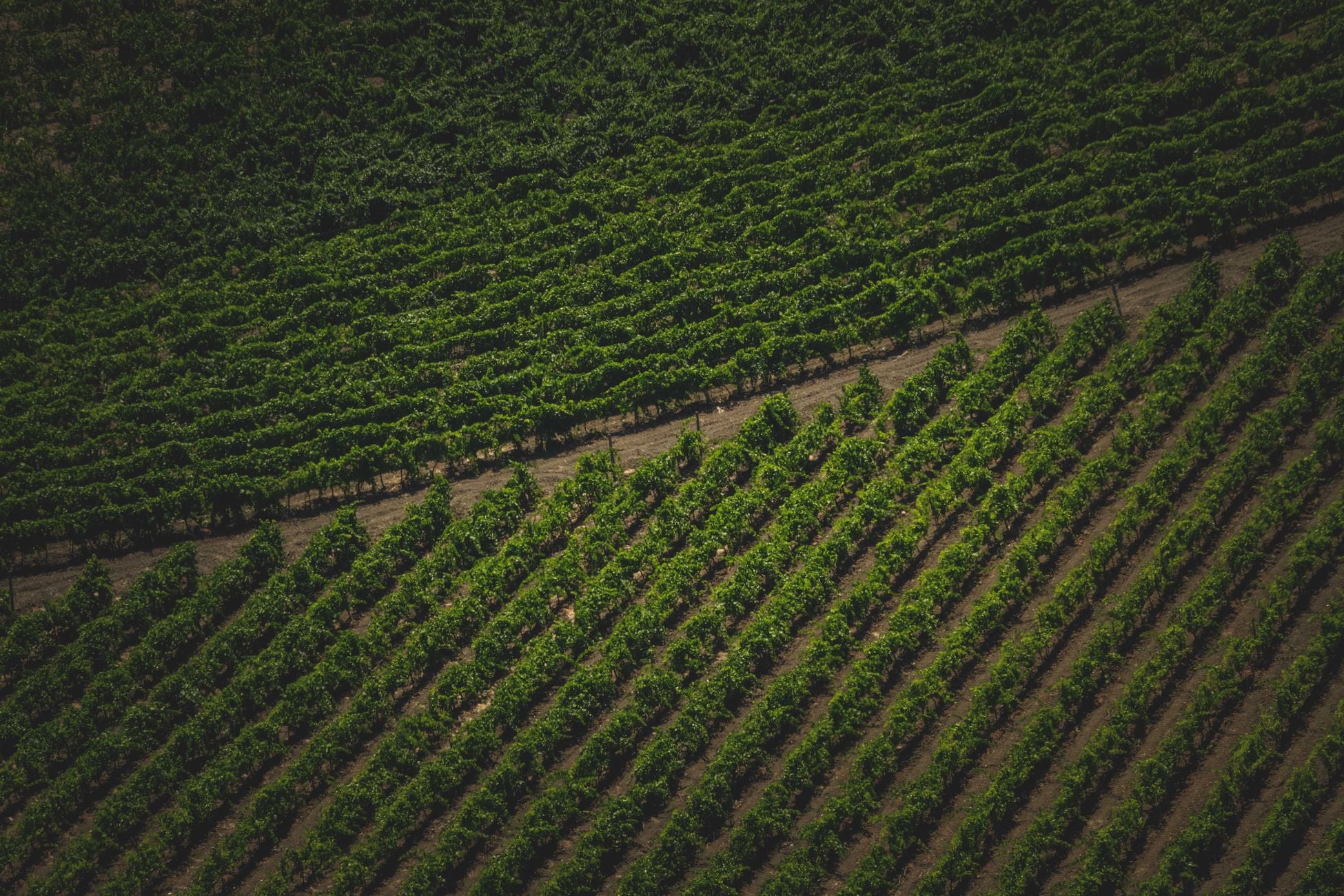
One of the strangest things about flying over Borneo today is the visual contrast from a plane window. On one side of a road: a tangled, multi-storey canopy with emergent trees breaking through, draped in epiphytes and lianas, belonging to one of the oldest rainforest systems on Earth. On the other side: a geometric grid of identical palms, each planted for yield, access, and harvest.
The grid is younger than most of the people looking at it. Oil palm plantations expanded rapidly across Malaysia and Indonesia in the final decades of the twentieth century and into the twenty-first. An ancient ecosystem is being swapped, in human-lifetime increments, for a crop younger than the Boeing 747.
Hills, fragments, and what remains
What forest survives is increasingly fragmented and pushed into places less convenient for large-scale clearance. A 2025 paper in Nature Cities found that hillside urban expansion is also creating extensive biodiversity threats worldwide, especially where development climbs into natural habitat and fragments what remains.
In Borneo, the remaining intact lowland dipterocarp forest, biologically the richest type, is now only a remnant of what it once was. Hill and montane forests matter too, but they host different species assemblages. They cannot simply replace the ecological role of lowland forest that has been cleared.
Conservation corridors, rehabilitation projects, and certified-sustainable plantations all exist, and some of them work. But the underlying arithmetic is hard. Oil palms reach commercial yield within a few years of planting. A dipterocarp tree takes decades to reach the lower canopy and far longer to reach the emergent layer.
The deep time, up close
Stand at the base of one of the surviving Shorea giants in Danum Valley or Lambir Hills and the trunk is wider than a small car is long. The buttress roots flare out into wings of wood taller than a person. Look up and the first branches start somewhere around the 30-metre mark, higher than many office buildings.
The lineage that produced that tree has been doing this on this island for longer than human imagination is built to hold. An oil palm planted next to it will be cut down and replanted several times before that Shorea finishes a single growth cycle. And in much of Borneo, the Shorea is already gone.
Call it what it is. A civilisation that inherited a 130-million-year-old forest decided, inside the working life of a single accountant, that it preferred margarine. The dipterocarps were here before primates existed. They will not be here for our grandchildren. Nothing about that trade is reversible on any timescale that matters to the species making it, and the only honest thing left to say is that we knew, and we kept buying.
























