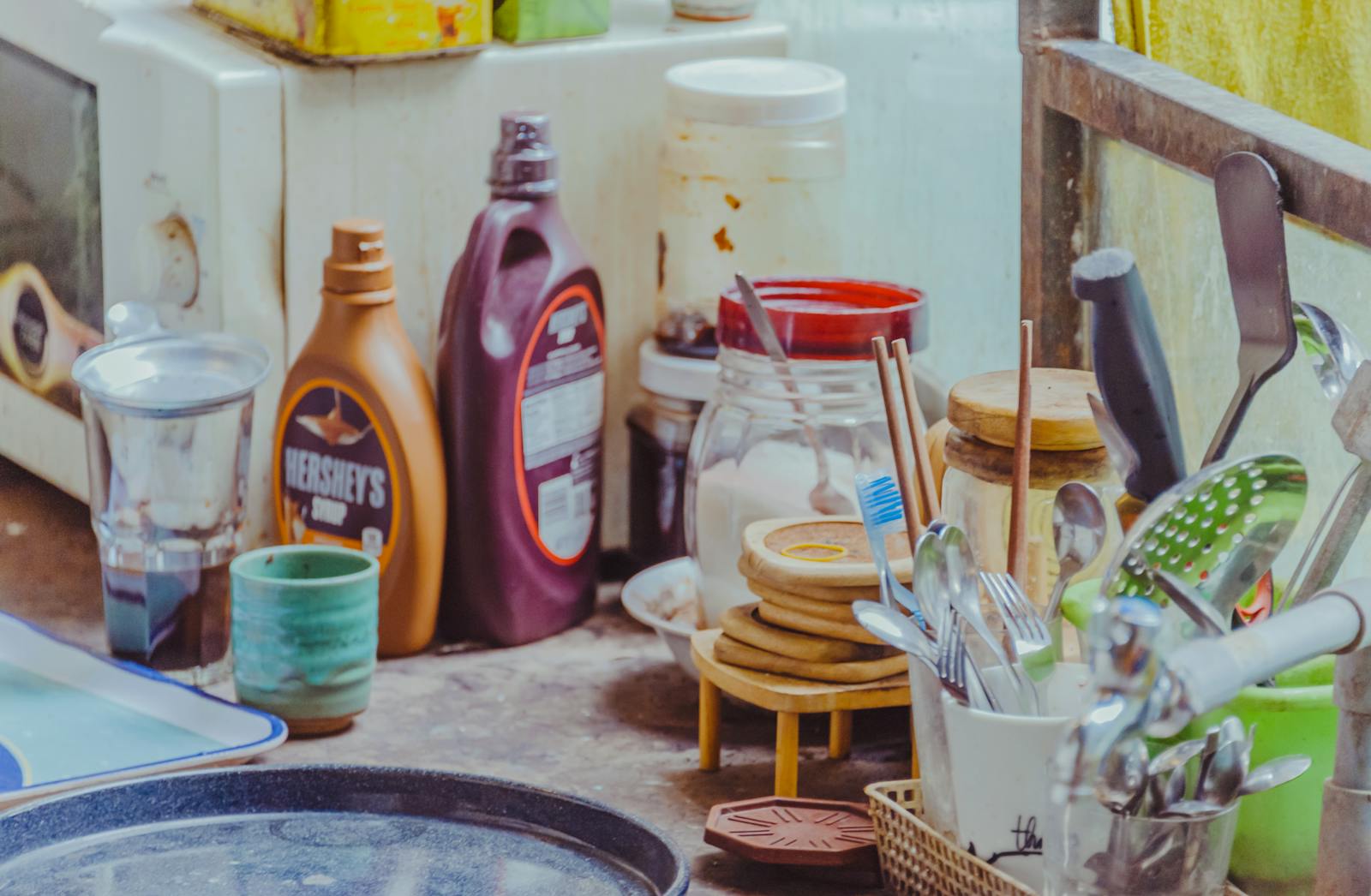
It’s a Saturday morning. Someone is wiping down the same stretch of kitchen counter for the third time, lifting the toaster to get the crumbs underneath, running a damp cloth along the base of the kettle. Outside, in the driveway, their car holds two weeks of receipts in the passenger footwell, a half-empty water bottle in the cupholder, and a hoodie balled up on the back seat that has been there since October.
Most people would read that as a contradiction. A person who can keep one space immaculate should be able to keep the other one passable. The pattern is actually consistent. It just operates on a rule the person learned so young they stopped noticing it: the spaces that get inspected get the effort, and the spaces nobody sees get whatever energy is left.
This is not laziness in the car. It’s not perfectionism in the kitchen. It’s a sorting system, installed in childhood, that divides life into front of house and back of house, and assigns labor accordingly.
The two-tier rule almost nobody names
If you grew up in a home where the living room was kept ready for an unannounced visitor but your bedroom was treated as your own problem, you learned something specific. You learned that cleanliness wasn’t really about cleanliness. It was about audience. The dish towels were folded for a guest who might never arrive. The hallway closet, behind its closed door, could be a hazard.
Kids absorb that distinction without anyone explaining it. They watch which surfaces get wiped down at 5pm on a Sunday because an aunt is coming by at 6. They notice which rooms get an apologetic disclaimer at the door and which rooms get the performance. They register which dishes go in the dishwasher and which ones get hand-dried because a particular relative will check. They learn that the front hallway has a different status than the back bedroom, and that the difference is not about square footage but about traffic. By adulthood, the division has become so internal that it shows up in places the original household never reached: a clean kitchen and a glove compartment full of receipts older than the lease. The rule outlives the house it was written in. It outlives the people who enforced it. It runs in the background the way a thermostat runs, adjusting effort to perceived audience without anyone having to think about it.
What the research actually says about critical households
The pattern intensifies in homes where criticism was a regular feature of childhood.
Children raised by highly critical parents tend to develop an oversized fear of being judged on performance, and that fear doesn’t stay attached to the original judges. It transfers to anyone who might walk through the door.
Therapist Patrick Teahan has described a recognizable trauma pattern in which people unconsciously recreate dynamics where they try to earn approval from those who are difficult to please. The spotless kitchen is one version of that. If the room a stranger sees is correct enough, maybe the stranger will be kind. Maybe the inspection will go fine. Maybe nobody will say anything cutting.
Psychotherapist Sharon Martin points out that when a child grows up with chronic criticism, self-worth gets tethered to how others treat them. The logical extension: the spaces others see become the spaces where self-worth is staged. The car, the inbox, the bedside drawer, the inside of the handbag, those exist outside the audit. They get the leftover self.
Why the car specifically gets neglected
Cars are a strange psychological space. They look public from the outside but feel intensely private from the inside. Nobody is invited in unless you offer. The passenger seat is a closed room you carry around with you.
So the car ends up archiving the parts of a life that have no other shelf. Empty Starbucks cups from a hard week. The hoodie you cried in. A water bottle from a trip you don’t want to throw away yet. People who keep an immaculate kitchen and a chaotic car are often not failing at car maintenance. They are using the car as the one space where the inspection rule doesn’t apply, where the standards their childhood installed cannot quite reach.
That’s why a partner cleaning out their car without asking can land as a far bigger violation than it looks. It’s not about the trash. It’s the only room left.
The kitchen as the inspection stage
The kitchen carries a particular weight in this sorting system. It’s where guests stand. It’s where deliveries are received. It’s where, in many households, the parent’s competence was on display and judged by extended family. A kitchen with a sink full of dishes wasn’t a logistics issue. It was character evidence.
Greater Good Science Center’s reporting on family estrangement notes how the standards parents are measured against have widened dramatically, with behaviours once considered ordinary now read as formative. The reverse is also true. Behaviours children once read as ordinary, the constant tidying of certain rooms, the panic before a relative visited, are now being recognised as something that shaped them.
Sociologist Stephanie Coontz, quoted in that piece, observes that for most of history family life ran on mutual obligation rather than mutual understanding. The spotless kitchen was an obligation discharged. Whether anyone in the family actually felt understood inside it was a separate question.
This is the same operating system, applied everywhere
Once you see the two-tier rule, you start seeing it everywhere in adult life.
It’s the desk that’s pristine while the Gmail inbox holds 14,000 unread messages. It’s the curated front porch and the garage you won’t open in daylight. It’s the bathroom guests use, scrubbed weekly, and the en-suite, which has had the same hair tie on the counter for three months. The sorting keeps running in the background, a nervous system trained to expect inspection that doesn’t get to relax just because the inspection is over.
It’s also the reason some people cannot rest until every email is answered: email is a public-facing room. Failing there feels like being caught with a dirty kitchen.
The energy economics of it
There is also a resource explanation, which sits alongside the psychological one. The literature on ego depletion and self-regulation has been contested and revised over the years, but the working observation remains: people allocate finite attentional and emotional energy according to perceived stakes. If maintaining the kitchen feels like a job with consequences and maintaining the car feels like a job nobody grades, the car loses every time.
The rule says: protect what’s visible, defer what isn’t. Calling this a moral failing misses the mechanism. It’s the most efficient possible response to a rule you didn’t choose.
What it costs in adulthood
The cost shows up quietly. The car becomes embarrassing to offer a ride in, so social invitations narrow. The handbag becomes a black hole, so finding the right card at the till becomes a small public humiliation. The private bathroom never quite gets the same dignity as the guest one, which means the person living there is, in a small daily way, treating themselves as a lower-tier resident in their own home.
The deeper cost is what it teaches you about yourself. If you only maintain the rooms strangers see, you are practising, every day, the belief that strangers’ opinions matter more than your own comfort. Most people would not endorse that hierarchy if asked directly. The floor plan endorses it anyway.
It can intensify with critical or controlling parents
For adults who grew up under sustained parental criticism, the front-of-house rule isn’t just a habit. It can become a survival posture that doesn’t switch off even when the parent is no longer in the room or, in some cases, no longer in the person’s life at all. Psychology Today’s coverage of parental dynamics that continue into adulthood notes that the patterns adult children developed to manage a difficult parent often outlast the relationship itself. The kitchen stays inspection-ready long after the inspector has stopped visiting.
This is also why some adult children who have gone low-contact or no-contact still find themselves performing for an audience that isn’t there. The audience moved into their head a long time ago.
The arrangement underneath the arrangement
Once you understand that the kitchen and the car are running on the same rule, other small habits start to make sense too. The person who arranges the same three objects on their nightstand every single night is doing something related: making the private space at least predictable, even if it can’t be presentable. The person who runs their thermostat to a rule their parents set thirty years ago is also operating on an internalised script about which household values count.
These aren’t quirks. They’re the residue of a particular childhood logic, applied with admirable consistency.

What changes when you name it
Naming the rule is the first thing that changes it. Once the spotless kitchen and the disaster car stop looking like a contradiction and start looking like a policy, the policy becomes visible. The question that was never asked in the original household becomes available: why should the rooms strangers see get the best of me?
Most people who try answering that question honestly find they don’t actually believe what their behaviour has been arguing. They believe their own comfort matters. They believe a private room deserves dignity even if nobody ever sees it. They believe they shouldn’t have to dread someone opening their passenger door.
What they do with that gap between what they believe and what they practise is a separate matter, and not one the floor plan can answer for them.
It’s not inconsistency, it’s a childhood made visible
The friend whose kitchen could be photographed for a magazine and whose passenger seat you cannot sit in without moving three jackets is not telling you they have a character flaw. They are telling you, without meaning to, what their childhood taught them about audience and worth.
Somewhere, right now, a kettle is being wiped down for the second time this morning, and a car in the driveway is holding two weeks of receipts in the footwell, waiting for a Saturday that has not yet arrived.