Sickness is the only socially acceptable form of rest in most families, and the people who absorbed that lesson earliest are the ones who now feel a strange relief when they catch a cold. Not because they enjoy being sick. Because illness finally gives them what they could never give themselves: a reason to stop.
The conventional wisdom treats this as a time-management problem. People who can’t rest are told to schedule downtime, to prioritize self-care, to block out recovery the way they’d block out a meeting. As if the barrier were logistical. As if the person who hasn’t taken a full day off in three years simply forgot to put it in the calendar.
But that misses what’s actually happening. The inability to rest without a medical excuse isn’t a scheduling failure. It’s a belief system operating below conscious awareness, one that equates a healthy body at rest with moral failure.
The equation nobody taught you out loud
Most people who struggle to rest can’t point to a single moment where someone told them stillness was wrong. The lesson was absorbed through observation, through the emotional climate of a household. A parent who only sat down after the house was spotless. A family where someone lying on the couch in the afternoon prompted a comment, even a gentle one, suggesting that rest is a luxury.
Those two words do extraordinary damage over time.
This type of comment encodes a specific belief: that rest is a luxury, that someone who rests while others work is getting away with something. Children absorb this not as a sentence but as a formula. Rest equals laziness. Laziness equals bad. The only exception to this equation is physical inability. If you’re sick, you get a pass. If you’re well, you’d better be moving.
What makes this so hard to dismantle later is that it doesn’t feel like a belief. It feels like reality. The person who can’t rest on a Sunday afternoon doesn’t consciously think they’re not allowed to rest. They think they should really do something productive, and this sense of obligation feels as natural as gravity. It is gravity, for them. A force so constant it becomes invisible.
The nervous system doesn’t care about your moral code
Here’s where the biology gets uncomfortable for anyone still running this old equation. Your body needs parasympathetic activation (the state researchers call “rest and digest”) regardless of whether you’ve “earned” it. The autonomic nervous system has two main branches: the sympathetic system, which prepares you for action and threat, and the parasympathetic system, which promotes relaxation and recovery.
In a healthy system, these two branches trade off throughout the day. You activate, you recover, you activate again. The problem is that when someone has spent decades believing rest must be earned, their sympathetic system runs almost continuously. The body stays in a heightened state of alert even when there’s no real danger present.
And the body keeps score. Chronic sympathetic dominance doesn’t just feel uncomfortable. It changes digestion. It raises blood pressure. It disrupts sleep quality even when sleep duration looks fine. It makes you more reactive, more anxious, more irritable.
Then, eventually, you get sick.
And the sick body finally gets the parasympathetic activation the healthy body was denied all along. The cold or the flu forces the nervous system into recovery mode. The person doesn’t just rest physically. They experience the first genuine downshift their nervous system has had in months.
No wonder it feels like relief.
The productivity trap that looks like ambition
I wrote recently about people who keep working past the end of the workday, and how the extra hour of productivity is often cheaper (emotionally) than the ten minutes of silence that would follow stopping. The same mechanic operates here, but at a larger scale.
When your identity is built on output, rest threatens more than your schedule. It threatens your sense of self. The person who only stops when sick has typically built an entire self-concept around doing, producing, being useful. Take away the doing and they’re left with a question they don’t know how to answer: who am I when I’m not being productive?
Running my own company after leaving consulting taught me this in the most unglamorous way possible. Irregular sleep, too much coffee, stress eating through deadlines. My body was sending signals for months that I needed to slow down, and I ignored every one of them because I genuinely could not distinguish between “resting” and “failing.” Those two concepts occupied the same space in my mind.
That conflation is the core of the problem. And it doesn’t come from nowhere.
Where the equation gets installed
The belief that rest must be earned through suffering or collapse typically originates in one of three environments, and what they share is more important than how they differ. Each one teaches the same lesson through a different channel: that your value is contingent on what you produce, and that a body at rest is a body in debt.
The first is the household where rest was punished socially. Not through violence or explicit rules. Through tone. Through the parent who sighed when you sat down. Through the sibling who got praised for never stopping. Through the ambient message that stillness was suspect and productivity was the only reliable route to approval. There’s a powerful piece on Silicon Canals about people who grew up being told to figure it out, and how that looks like strength from the outside but feels like a locked door from the inside. The same applies here. These children didn’t choose to become people who can’t stop. They were shaped into it.
The second is the environment where only visible suffering warranted care. In some families, the price of receiving attention or tenderness was proof of damage. You had to be visibly unwell, visibly struggling, before someone asked how you were. A healthy child asking for comfort received a different response than a sick child asking for the same thing. That child grows up and the pattern persists. They can ask for a day off when they have a fever. They cannot ask for a day off because they’re tired, because their brain won’t quiet down, because they haven’t had a genuine break in six weeks. Those reasons don’t feel valid. Fever does.
The third is the culture that equates worth with output, which compounds everything the first two environments installed. Corporate culture, hustle culture, the glorification of people who never take sick days. I spent my twenties and early thirties in environments where taking all your vacation days was quietly noted as a character flaw. Not in any policy document. In the way people talked about each other. Comments about using full leave allocation were said with the same inflection as comments about lacking commitment.
What makes these origins so persistent into adulthood is that they don’t stay external. A child who watches rest get punished doesn’t just learn a rule about rest. They internalize an authority figure who enforces that rule from the inside. By the time they’re thirty-five, nobody needs to sigh when they sit down. They sigh at themselves. The surveillance has been fully automated, and the original source has been forgotten. It no longer feels like a belief someone gave them. It feels like who they are.
What the body does when permission is never granted
When someone consistently overrides their need for rest, the autonomic nervous system adapts. Research on nervous system dysregulation shows that chronic stress can lead to a state where the sympathetic system dominates, keeping the body in a near-constant fight-or-flight mode even when no external threat exists. The body’s ability to self-regulate breaks down.
The symptoms are familiar to almost everyone reading this: disrupted sleep, digestive problems, a baseline level of anxiety that never fully resolves, difficulty concentrating. And here’s the part worth sitting with: emerging clinical findings suggest that autonomic dysfunction may even contribute to treatment-resistant depression, meaning the inability to shift into recovery mode doesn’t just feel bad. It can make other interventions less effective.
The person who only rests when sick is not being dramatic. Their body is doing exactly what it was trained to do: wait for catastrophe before switching gears.

And here’s the bitter irony. The repeated cycles of overwork followed by crash followed by overwork actually damage the nervous system’s ability to transition smoothly between activation and recovery. The longer the pattern runs, the harder it becomes to rest without being forced into it. The capacity for voluntary rest atrophies.
Why “just rest” is useless advice
Telling someone with this pattern to just take a break is like telling someone with a fear of heights to just look down. The problem isn’t that they don’t know rest exists. The problem is that rest, for them, triggers a cascade of discomfort that feels indistinguishable from danger. The nervous system, accustomed to constant activation, interprets the absence of activity as a threat. Calm feels wrong. Stillness triggers the same alarm response that, in another person, might be triggered by an actual emergency. I explored this pattern in my recent piece on people whose operating systems were built for emergencies, where peace registers as a system error.
The work, then, isn’t about scheduling more breaks. It’s about retraining the nervous system to tolerate rest without interpreting it as failure or danger.
What actually helps (and what it looks like)
The research on breathing and emotional regulation points to something useful here. Just five minutes of slow, controlled nasal breathing can activate the parasympathetic nervous system and begin shifting the body out of its chronic alert state. The key word is “begin.” This isn’t a quick fix. It’s a practice that, repeated over weeks and months, teaches the nervous system that downshifting is safe.
But the breathing matters less than the permission. And the permission has to come from somewhere other than illness.
What I’ve seen work, in myself and in others, follows a rough pattern:
First, naming the equation. Most people running this pattern have never articulated it. Saying out loud that they believe they have to earn rest through suffering is genuinely uncomfortable. But the belief loses some of its power once it’s stated explicitly, because stated explicitly, it sounds like what it is: an inherited rule, not a law of physics.
Second, practicing micro-rest without justification. Not a two-week holiday. Five minutes of sitting with no phone, no book, no purpose. The discomfort will be immediate and intense. That discomfort is the point. It’s the belief system protesting. Each time you sit with it and nothing bad happens, the equation weakens slightly.
Third, separating rest from collapse. The person caught in this cycle typically rests in only two modes: productive relaxation (reading something “useful,” listening to an educational podcast) or total collapse (sick in bed, unable to function). The middle ground, resting simply because you want to, is the skill they never developed. Developing it feels alien at first. That’s expected.
A health scare in my early forties, one that turned out to be nothing, forced me to confront how much of my identity I’d staked on never stopping. The scare itself wasn’t the lesson. The lesson was the relief I felt when the doctor told me to take it easy for a week. I didn’t want to be sick. I wanted the permission that came with being sick. That distinction changed how I thought about everything.
For anyone recognizing themselves in this pattern, three specific interventions are worth trying, not because they’re dramatic, but because they directly interrupt the equation at the level where it operates:
1. Scheduled purposelessness. Block fifteen minutes on your calendar, three times a week, with no assigned activity. Not meditation, not breathwork, not journaling. Nothing. The goal is to sit with the discomfort of unearned stillness until your nervous system stops treating it as an emergency. Start with five minutes if fifteen feels impossible. The point isn’t the duration. The point is that you chose rest without a justification.
2. Decouple rest from your physical state. The next time you notice yourself feeling tired but pushing through because you’re “not sick enough to stop,” stop anyway. Say the reason out loud: “I’m resting because I’m tired.” Not because you have a fever. Not because you can’t physically continue. Because you’re tired and that is enough. This will feel fraudulent the first dozen times. That feeling is the old equation asserting itself. Let it protest. Rest anyway.
3. Track the permission patterns. For two weeks, notice every time you rest and write down what gave you permission. A headache. A cancelled meeting. Someone else suggesting it. Rain. You’ll start to see the architecture of the belief system clearly: the elaborate scaffolding of excuses you’ve built to do something your body has a right to do for no reason at all. Seeing the scaffolding is the first step toward not needing it.
The deeper question underneath
If you only feel allowed to rest when your body forces you to, the question worth asking isn’t how to rest more, but rather: who told you that you had to earn the right to be still?
Because someone did. Maybe not in words. Maybe in the way they lived, in what they praised, in what they withheld. And the equation you absorbed from watching them has been running your operating system ever since, disguised as discipline, disguised as work ethic, disguised as the voice in your head that says “not yet” every time you consider stopping.
A healthy body has a valid claim to stillness. That sentence will feel wrong to the people who most need to hear it. The wrongness is the belief talking.
The illness was never the problem. The illness was the loophole. And the loophole only existed because somewhere, a long time ago, the front door got sealed shut. Rest became something you had to sneak in through the back, wrapped in a fever, justified by a doctor’s note, earned through enough visible suffering that nobody could accuse you of simply wanting to stop.
You can unseal that door. But it requires accepting something that the equation was specifically designed to prevent you from believing: that you are allowed to stop before you break.
Not after. Before.
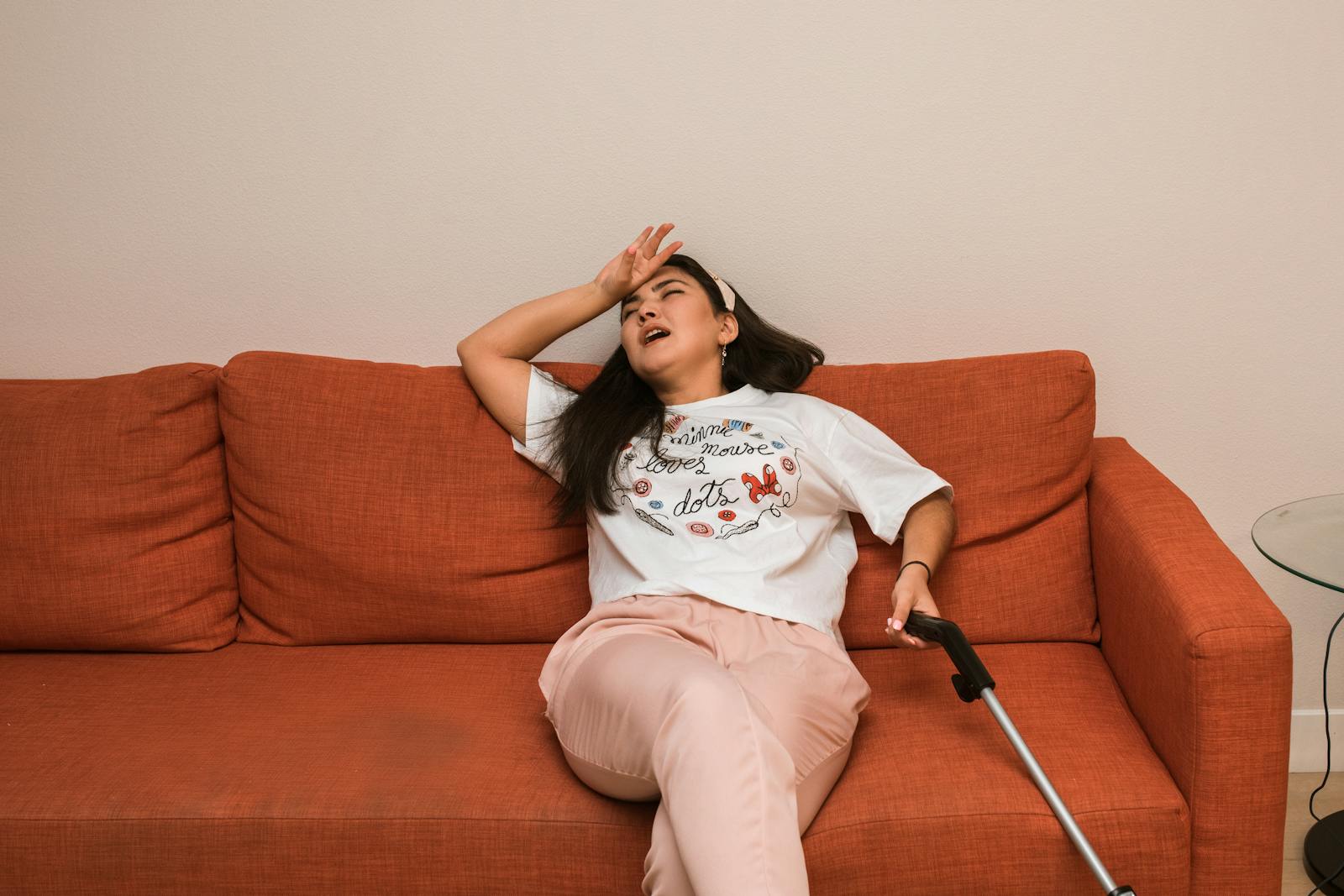
Feature image by RDNE Stock project on Pexels